
On May 11, 868 CE, a man named Wang Jie commissioned the printing of a Buddhist text called the Diamond Sutra. The scroll, just over sixteen feet long and assembled from seven strips of yellow-stained paper, became the oldest dated printed book in the world. It now sits in the British Library, almost twelve centuries removed from the moment it was made.
We tend to tell this story as a triumph of technology. A man, a woodblock, the dawn of print. What gets lost in that framing is the actual motivation.
Wang Jie was not an innovator looking for scale. He was a Buddhist practitioner consumed by a very specific fear: that sacred teachings, passed hand to hand through manual copying, would drift, corrupt, and eventually disappear. Every time a monk copied a sutra by hand, small errors crept in. Passages shifted. Characters were misread, misremembered, misrendered. Across enough copies and enough time, the original meaning would be gone, replaced by a thousand confident variations of it.
The colophon at the end of the scroll tells you everything. It reads, in translation: “Reverently made for universal free distribution by Wang Jie on behalf of his two parents.” This was not a commercial venture. It was not ambition. It was an act of preservation driven by the fear that without a better system, the thing he cared about would not survive at scale.
Woodblock printing was not primarily faster than copying by hand. It was fundamentally different in kind. It did not reduce variation. It eliminated it. Every copy produced from the same block was identical. The message could not drift. The teachings could not corrupt. The fear of entropy had produced the world’s first printed book.
Wang Jie did not invent printing to scale knowledge. He did it to protect it from entropy.
That distinction matters more than it might seem. And it matters a great deal right now, in 2026, as companies everywhere race to adopt artificial intelligence.
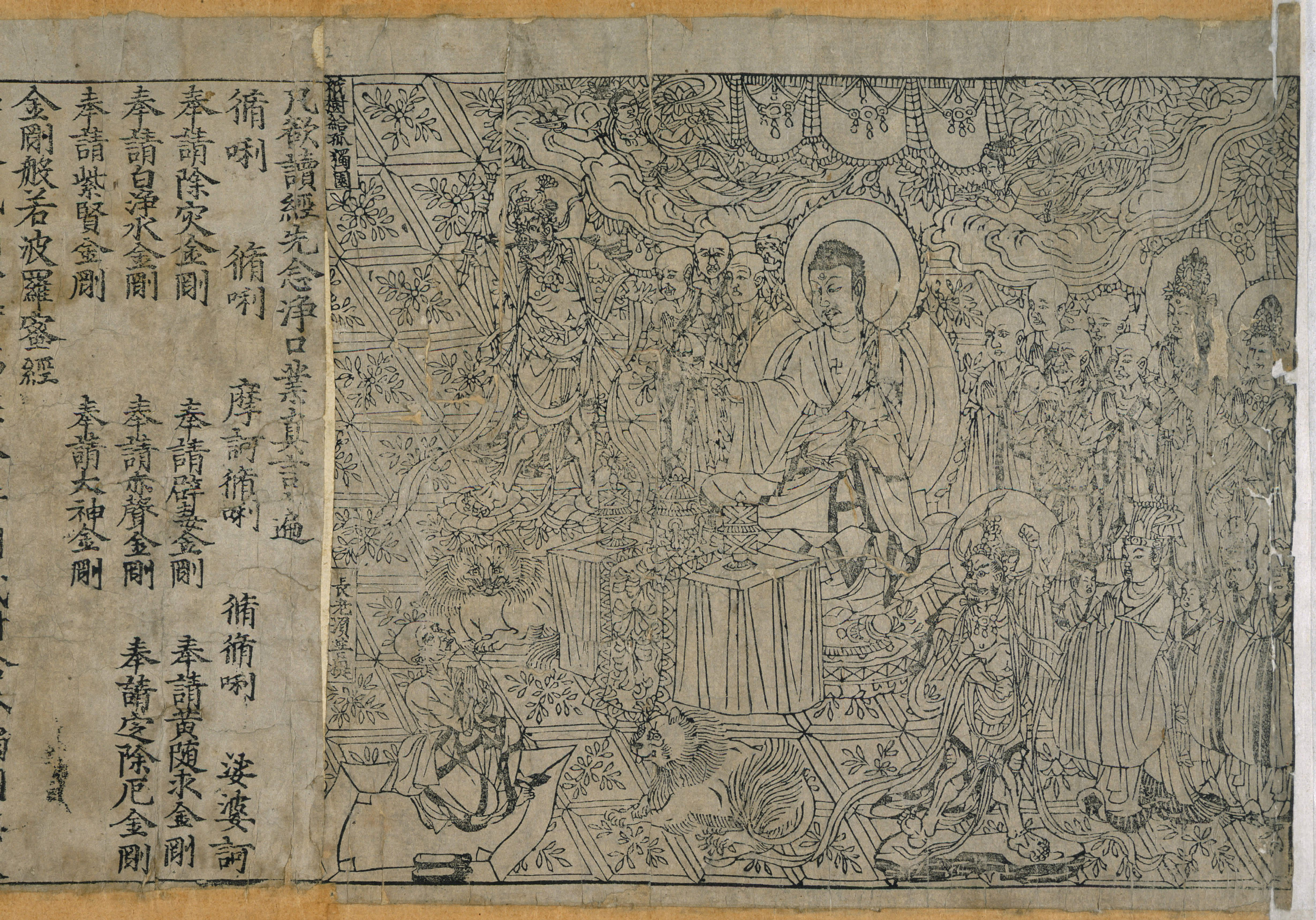
By The colophon, at the inner end, reads: Reverently [caused to be] made for universal free distribution by Wang Jie on behalf of his two parents on the 13th of the 4th moon of the 9th year of Xiantong [i.e. 11th May, CE 868 ]. - Zoomable image from the British Library’s Online Gallery. Originally uploaded to en:Wikipedia (log) in January 2008 by Fconaway (talk) and in November 2009 by Earthsound (talk)., Public Domain, https://commons.wikimedia.org/w/index.php?curid=6925162
The Manuscript Era of AI
Walk into most organizations experimenting with AI today and you will find something that looks, structurally, a lot like a ninth-century scriptorium.
The marketing team is using one set of tools with prompts they have built themselves. The product team is using a different model with different instructions and different guardrails. Customer support has deployed a chatbot that nobody in engineering has audited. Finance is running summarization workflows that legal has never seen. And someone in operations built a workflow six months ago that nobody else knows exists, producing outputs that vary meaningfully every time the underlying model gets updated.
Each team is working hard. Each team believes it is doing the right thing. The problem is not effort or intent. The problem is what happens when you add them all together.
This is the hand-copying phase of AI. And it carries the same risks Wang Jie was trying to solve.
The 2024 McKinsey State of AI survey found that 63 percent of companies using generative AI have no governance structures in place for managing the associated risks. Deloitte’s 2026 State of AI in the Enterprise report found that worker access to AI rose 50 percent in a single year, while only one in five companies has a mature governance model for autonomous AI agents. BCG research found that 74 percent of companies struggle to achieve value from AI at scale.
The gap between adoption and infrastructure is exactly what you would expect to see in the early days of any transformative technology. It is not a sign of failure. It is a phase.
But phases end. And the risks that accumulate during this one are not trivial.
Consider what happens when a company’s AI-generated customer communications are produced by four different teams using four different models with four different prompt conventions and no shared quality standard. The customer does not experience four teams. They experience one brand. And that brand is now producing outputs that no single human reviewed, designed, or can fully explain.
Or consider prompt drift: the phenomenon where the same task, run through the same model, produces meaningfully different outputs as the model is updated, the prompt is casually modified, or the context shifts. In a siloed environment, nobody is watching for this. Nobody owns it. By the time it surfaces, it has already shaped customer decisions, internal reports, or product behavior in ways that are difficult to trace.
This is not a technology problem. It is a systems problem. And it will not solve itself.
Right now, most companies are not scaling AI. They are copying sutras by hand.
The Printing Press Transition
The web offers a useful parallel. When the internet first emerged in the early 1990s, web development was a genuinely creative free-for-all. Every developer wrote their own HTML. Browsers interpreted that HTML in their own idiosyncratic ways. Netscape and Internet Explorer competed not by adhering to standards but by inventing new features faster than the other, leaving developers to write entirely different code for each browser just to make a single page render consistently.
It produced extraordinary innovation. It also produced what historians of the web call “tag soup”: bloated, inconsistent, browser-specific code that was expensive to maintain and impossible to scale. The more ambitious a site became, the more the inconsistency compounded.
The Web Standards Project, launched in 1998, was not an attempt to slow innovation down. It was an attempt to preserve what was working across the chaos of what wasn’t. HTML 4.0 and CSS gave developers a shared language. When browsers finally converged on those standards in the early 2000s, web development did not become less creative. It became far more scalable. The constraint turned out to be the foundation.
This is the pattern. Exploration precedes standardization. Standardization enables scale. The critical variable is timing.
Standardize too early and you kill the learning. The value of the manuscript phase is real. Teams experimenting independently discover what actually works. You cannot skip that stage. You need local learning before global standards, because the right standards emerge from practice, not from anticipation.
Standardize too late and the chaos calcifies. Inconsistency becomes debt. Every workaround, every team-specific convention, every undocumented prompt library becomes a thing someone has to unwind before you can build a coherent system on top of it. Like technical debt, this kind of AI debt compounds with time and scale.
The question is not whether to standardize. It is when, and what.
What Leaders Should Actually Do
The takeaways here are not about tools. They are about what Wang Jie actually did: he identified what was worth preserving, built the infrastructure to preserve it, and made the right approach the only approach. That sequence matters.
Let teams explore, for now. You are almost certainly still in the manuscript phase and that is not a problem. You need the variation. Teams experimenting independently are generating the evidence base you will need to make good decisions about what to standardize. The goal right now is not to stop the copying. It is to watch what the best copies have in common.
Watch for signal, not noise. Most of what teams are experimenting with will not survive contact with reality. A small number of prompts, workflows, and use cases will consistently produce results that are reliable, repeatable, and valuable. Those are the woodblocks. Pay attention to what works across contexts, not just what works in the team that built it.
Standardize patterns, not tools. The trap is to conflate standardization with vendor lock-in. You do not need everyone using the same model. You need everyone working from shared conventions about how AI outputs are reviewed, how prompts are versioned, how sensitive data is handled, and what constitutes an acceptable output in a customer-facing context. The printing press standardized the process, not the content.
Build printing presses, not rulebooks. Policies without infrastructure are just friction. If you want teams to follow shared practices, the shared practices need to be easier than the workarounds. An internal prompt library that teams actually use beats a governance document that nobody reads. An approved model stack with sensible defaults beats a policy prohibiting unapproved tools. Make the right way the easy way.
Time the shift deliberately. This is the hardest part. There is no universal answer to when your organization moves from exploration to institutionalization. But there are signals. If you are seeing customer-facing inconsistencies driven by AI outputs, that is a signal. If teams are reinventing the same workflows independently and producing different results, that is a signal. If a model update breaks something important and nobody knew it was coming, that is a signal. These are not technology problems. They are manuscript-era problems. They tell you the transition is overdue.
From Preservation to Scale
The Diamond Sutra did not survive twelve centuries because people cared deeply about it. Plenty of things people cared deeply about were lost. It survived because Wang Jie built a system that ensured copies would remain faithful to the original, regardless of who made them or when.
That is what AI transformation actually requires. Not discovery of what is possible, which is genuinely exciting and genuinely important, but a deliberate decision about what is worth preserving once you have discovered it. What works. What is reliable. What, when scaled, produces the outcome you actually wanted rather than a confident variation of it.
The organizations that will lead in AI are not the ones with the most experiments running right now. They are the ones that know when to stop copying by hand.
Every company experimenting with AI is writing its own sutras. The question is: when do you stop copying them by hand, and start printing them?
The transition will not be comfortable. Standardization never is. But the alternative, allowing the manuscript era to calcify into the default way of working, is how you end up with a scriptorium when your competitors have a press.