
Every great writer seems to agree on one thing: write every day.
Stephen King is famously disciplined about it, producing thousands of words with near-mechanical consistency. Haruki Murakami approaches writing like endurance training, pairing it with long runs and rigid routines. John Grisham built his early career by waking up before work each morning to write in small, steady increments. And Daniel Pink has argued that our lives are ultimately shaped by what we do consistently, not occasionally.
It’s hard to argue with any of this. The logic is clean, the evidence overwhelming. Practice compounds. Repetition builds skill. Consistency removes the friction of starting. If you want to get good at something, you should do it regularly.
I don’t follow that advice.
I don’t write every day. I don’t keep a fixed schedule. I don’t sit down and force output when I don’t feel ready. And yet, over time, I’ve managed to write quite a bit. Just not in a way that resembles the standard playbook.
The difference isn’t that I reject discipline. It’s that I apply it somewhere else.
The Model Most of Us Are Taught
The “write every day” model works because it reduces uncertainty. You don’t wait for inspiration; you create conditions where inspiration is less necessary. Writing becomes a habit rather than an event. Over time, the mechanics fade into the background, and you develop fluency.
This pattern shows up far beyond writing. In engineering, we rely on continuous integration and deployment for similar reasons. Small, frequent changes reduce risk and increase reliability. In testing, iteration improves quality. The system gets better because it runs constantly, not because each individual run is perfect.
This approach optimizes for throughput. It’s designed to produce output consistently, and in many domains, that’s exactly what you want. If you’re learning a new skill or trying to build momentum, repetition is the fastest path forward.
But not all work is constrained by throughput. Some work benefits less from frequency and more from depth.
What I Actually Do
Instead of writing every day, I keep a running list of ideas.
Some are well-formed, but most aren’t. They’re fragments, an observation from a meeting, a question that doesn’t quite have an answer, a pattern I think I’m seeing but can’t yet articulate. Often it’s just a title with no content behind it, something that feels interesting without being clear why.
I don’t immediately act on these ideas. I capture them and move on.
Over time, I revisit the list. Not on a strict cadence, but periodically, usually when something else I’m working on reminds me of it. What I’ve found is that most ideas don’t hold up. They felt compelling in the moment, but when revisited, they don’t have enough substance to justify writing about. They fade quietly, replaced by new ones.
But a few behave differently.
They come back. They connect to other things I’m seeing or reading. They evolve slightly each time I think about them. Instead of losing energy, they gain it. They become harder to ignore.
Eventually, one of them reaches a point where it’s no longer optional. I’m not deciding to write it; I’m reacting to it. The structure is already there, the argument mostly formed. The act of writing is less about creating something new and more about capturing something that’s already been developing.
When that happens, the writing flows in a way that feels very different from forced output. It’s not effortless, but it’s directed. The hard thinking has already been done.
The Psychology Behind It
There’s a concept in psychology called the Zeigarnik effect, which suggests that people remember unfinished tasks better than completed ones. Open loops linger in our minds. They create a subtle tension that doesn’t fully resolve until the task is complete.
Most of us experience this as a distraction. An incomplete task keeps pulling at our attention when we’d rather focus on something else.
I’ve come to see it differently.
Each idea I capture is an open loop. By not immediately closing it, I’m effectively handing it off to my subconscious. It continues to process in the background, connecting the idea to new inputs, refining it, or discarding it altogether.
Over time, this creates a natural filtering mechanism. Weak ideas lose their tension and disappear. Strong ideas accumulate it. They persist, not because I’m forcing them to, but because they continue to feel unresolved.
Eventually, the tension becomes high enough that writing is the only way to release it.
In that sense, I’m not practicing writing every day. I’m practicing leaving things unfinished long enough for the right ones to become inevitable.
Two Different Ways to Create
The more I’ve thought about this, the more it seems like there are two distinct models of creative work, and we tend to talk about only one of them.
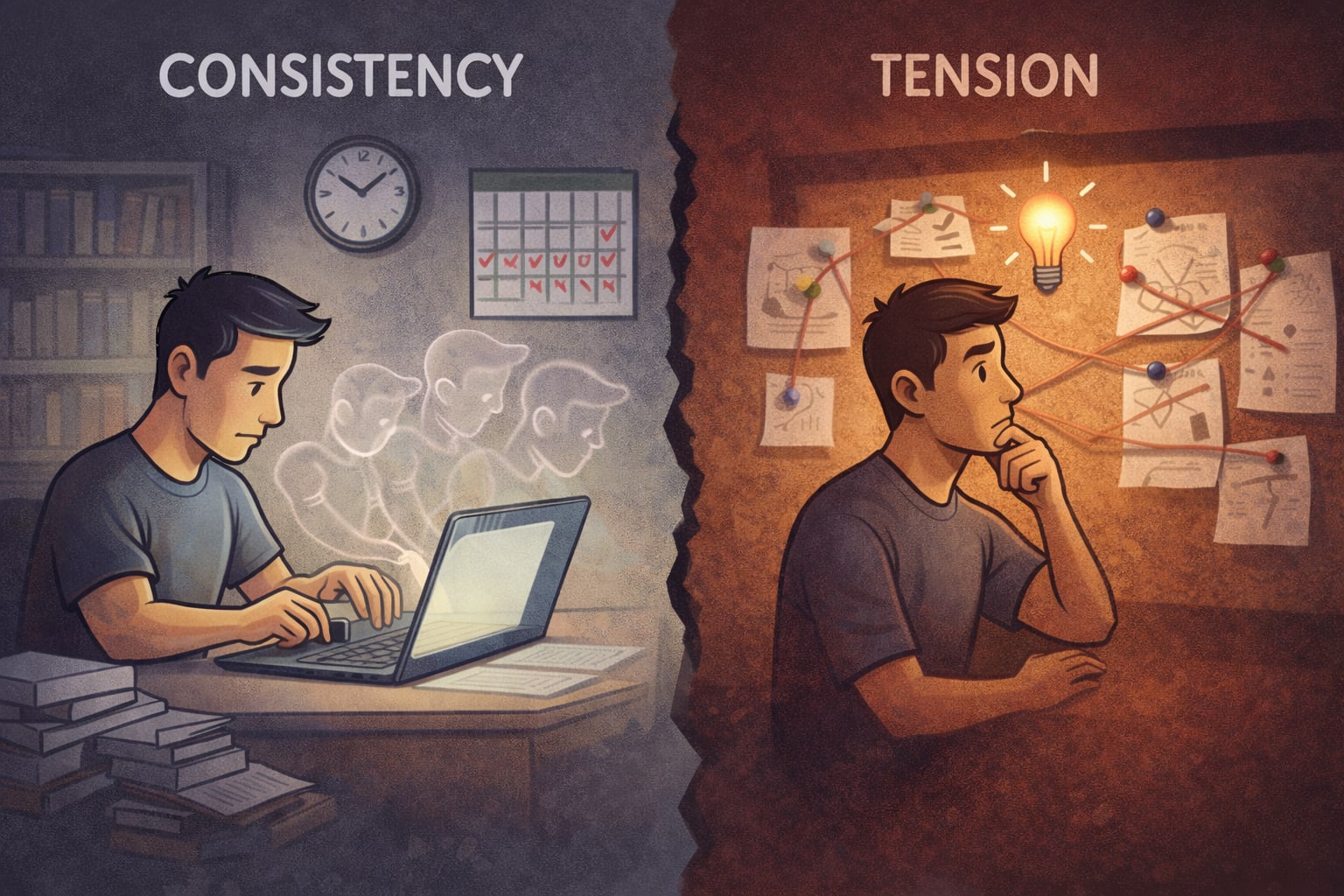
The first is the discipline loop. You take in inputs, produce outputs, and repeat the process on a regular cadence. This model builds skill through repetition and reduces dependence on mood or inspiration. It’s reliable, scalable, and broadly applicable.
The second is what I think of as the tension loop. You capture inputs, allow them to incubate, and let unresolved ideas build pressure over time. Output happens when that pressure crosses a threshold. This model is less predictable, but it tends to produce work that is more distilled, more connected, and often more original.
One model builds fluency. The other builds perspective. Both are useful. The mistake is assuming they are interchangeable.
Where This Shows Up in Product and Engineering
This distinction isn’t just about writing. It shows up in how we build products and lead teams, often in ways that aren’t immediately obvious.
In product development, we tend to default to the discipline loop. We maintain backlogs, prioritize work, and move items through the system as efficiently as possible. Progress is measured by throughput, how quickly we can turn ideas into shipped features.
There’s value in this. Without it, nothing gets built.
But it can also lead to a subtle failure mode. We treat all ideas as if they deserve immediate execution. The backlog becomes a queue rather than a filter, and we lose the ability to distinguish between ideas that are merely interesting and those that are actually important.
Time, in this context, is an underutilized tool.
Ideas that persist over time, that continue to surface in different forms across customer feedback, internal discussions, and market signals, are often the ones worth paying attention to. They behave the same way strong writing ideas do. They don’t fade; they accumulate tension.
When we rush to execute everything, we remove that filtering mechanism.
The Risk of Moving Too Quickly
One of the more common patterns I’ve seen in product teams is premature convergence. A problem is identified, and the team quickly aligns on a solution. From there, the machinery kicks in, design, build, ship, measure, iterate.
On the surface, this looks like progress. And sometimes it is.
But often, it’s a sign that we didn’t spend enough time understanding the problem in the first place. We closed the loop too early. The solution may be coherent, even well-executed, but it’s anchored to an incomplete understanding of the underlying issue.
This is where second-order effects start to appear. Features interact with user behavior in ways we didn’t anticipate. Metrics improve in the short term but drift away from the broader mission. What looked like a clean solution turns into a more complex problem over time.
As I’ve written before, every product release is effectively an experiment in human behavior. The quality of that experiment depends on the quality of the thinking that precedes it. And good thinking often requires resisting the urge to act too quickly.
Slack and the Space to Think
In engineering, we’ve learned that running systems at full capacity all the time creates fragility. Without slack, small issues compound into larger ones. Bugs accumulate, technical debt grows, and eventually the system slows down more than it speeds up.
The same principle applies to thinking.
If every moment is allocated to execution, there’s no space for ideas to develop beyond their initial form. Everything is acted on in its earliest, least refined state. The result is a steady stream of output, but not necessarily better output.
Slack, in this context, isn’t wasted time. It’s where refinement happens. It’s where weak ideas are discarded and strong ones are strengthened. When we eliminate slack, we don’t just move faster. We reduce the depth of our thinking.
Leadership and the Discipline of Waiting
This is where the distinction becomes most relevant for leadership.
Leaders are often evaluated on decisiveness. The ability to make quick, confident decisions is seen as a strength. And in many situations, it is. But there’s another, less visible skill that matters just as much: the ability to hold ambiguity without rushing to resolve it.
Leaving loops open is uncomfortable. Teams want direction, stakeholders want clarity, and there’s constant pressure to move forward. The temptation is to close the loop as quickly as possible, to replace uncertainty with action.
But not all problems benefit from immediate resolution.
Some require time to fully understand. They need to be reframed, tested against new information, and viewed from multiple perspectives. They need to accumulate context.
This isn’t indecision. It’s a different kind of discipline, the discipline to wait until the problem is clear enough that the solution, when it comes, is actually the right one.
Balancing the Two
None of this is an argument against consistency or practice. Those things are essential, especially when you’re building foundational skills or trying to create momentum.
But they’re not universally optimal.
The most effective creators, and the most effective leaders, seem to operate in both modes. They maintain systems for capturing ideas and engaging regularly with their work, but they don’t force output for the sake of output. They allow certain ideas to sit, to evolve, and to compete for attention over time.
They recognize that some value comes from doing more, and some comes from waiting longer.
Closing the Right Loops
Consistency is easy to measure. You can count the days you wrote, the number of commits, the features shipped. It’s visible, which makes it appealing.
What’s harder to see is the thinking that didn’t happen, the ideas that were never fully developed, the problems that were solved too quickly, the consequences that were never considered.
Some of the most important work happens in that invisible space, where nothing appears to be happening but everything is quietly evolving.
In writing, that’s incubation. In product, it’s judgment. In leadership, it’s restraint.
The goal isn’t to close loops faster.
It’s to understand which ones are worth leaving open long enough to matter.