
Three years ago, I started writing Fish Food for Thought as a way to think out loud, to process what I have learned as a leader, test ideas in the open, and connect with other people wrestling with the same questions.
I write because it helps provide me with clarity of thought. Each post forced me to take a half-formed idea or something nagging at me and work it into something coherent. Some posts landed, some didn’t. But all of them taught me something.
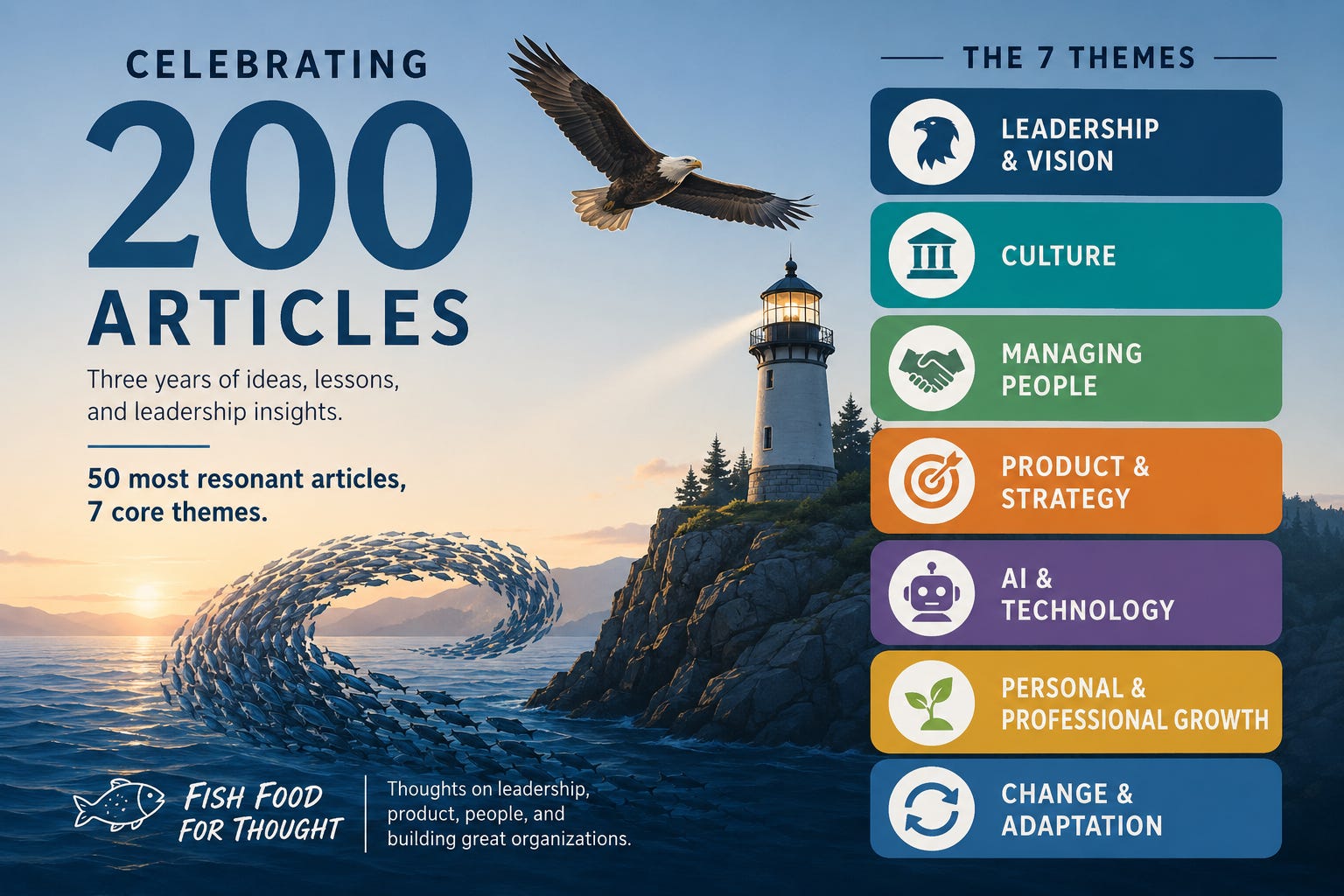
This post marks the 200th article. To help celebrate that, here are the 50 articles that resonated most with folks. The ones readers shared, debated, and came back to. I’ve organized them into seven themes that, taken together, represent the map I carry as a leader and operator.
I hope they’re useful to you.
In this post
🦅 Leadership & Vision
🏛️ Culture
🤝 Managing People
🎯 Product & Strategy
🤖 AI & Technology
🌱 Personal & Professional Growth
🔄 Change & Adaptation
🦅 Leadership & Vision
#1 The Shape of Leadership - Leadership Lessons from Birds That Know When to Lead and When to Adapt
Great leaders know when to take charge and when to follow. Drawing on the breathtaking collective behavior of murmurations, this post reimagines what modern adaptive leadership looks like.
#2 Leadership Principles - Part 1 - Self-Awareness, Technical Mastery, and Team Welfare
The foundation of great engineering leadership rests on three pillars: self-awareness, technical mastery, and genuine care for your team. This post unpacks each one with practical examples drawn from real organizations.
#3 Visionary Leaders and Product Success - A Closer Look
A clear product vision doesn’t just inspire the team, it fundamentally shapes what gets built and how. This post examines the patterns connecting strong product leaders to winning outcomes.
#4 No More Mr. Nice Guy - Why caring means making the hard decisions
Real care isn’t about avoiding hard conversations, it means making difficult decisions in service of your people and your mission. The most caring thing a leader can do is be honest, even when it’s uncomfortable.
#5 Speed Is Never Just Speed - What rugby can teach us about leadership
There’s a lot more going on underneath the surface when we talk about moving fast. Drawing on rugby’s concept of decision-making under pressure, this post explores what velocity actually means in leadership.
#6 The Impact of One Great Leader - How a sentence changed my career
A single sentence from a mentor changed the way I approached my entire career. This post explores the outsized, often invisible impact that one exceptional leader can have on the people around them.
#7 Leading Through Ambiguity - Create Alignment, Not Illusion
Creating alignment when the path isn’t clear is one of the hardest jobs in leadership. This post lays out a framework for making decisions and maintaining team confidence even when the answers aren’t obvious.
#8 Executive Amplification - Why what leaders say matters more than they think
A CEO once mentioned offhand that there were “no blueberry muffins,” and his team spent years stocking them at every meeting. This post explores executive amplification, the outsized effect a leader’s words, behaviors, and even calendar choices have on the organization, and what leaders should do once they realize how loudly they’re being heard.
🏛️ Culture
#9 Culture - Which is the best?
Not all cultures are the same. Some organizational models are dramatically more effective than others. This post compares different cultural archetypes and helps leaders identify which one their organization has, and whether it’s the one they want.
#10 Culture Debt - The Invisible Interest of Speed
Just like technical debt, cultural shortcuts accumulate and eventually demand repayment. This post introduces the concept of culture debt, the hidden cost of deprioritizing culture in favor of speed.
#11 How Culture Scales (or Doesn’t) - The Uneven Path of Growth
Culture that works beautifully at 20 people can break completely at 200. This post traces the uneven path of cultural evolution as organizations grow and what leaders can do to stay ahead of it.
#12 Teamwork - Working together makes all the difference
The best products and outcomes almost never come from individuals alone. This post makes the case for investing in team dynamics, and explores what working well together actually requires in practice.
#13 Cultivating a Culture of Excellence - Goals, Metrics, Experimentation, and more
Excellence at scale doesn’t happen by accident - it requires goals, metrics, experimentation, and constant reinforcement. This post lays out a practical approach to building and maintaining a culture that expects and rewards great work.
#14 Conflict - Sometimes it is useful
Contrary to what most managers believe, conflict isn’t something to eliminate, it’s something to use well. This post explores how productive tension and well-managed disagreement are hallmarks of strong, healthy teams.
#15 The Brilliant Jerk vs. Team Performance - Why The Team Always Wins
A single high-output but destructive team member can undermine the performance of an entire group. The research is clear, protecting team dynamics is worth more than any individual contribution.
🤝 Managing People
#16 Management - The most noble of professions
Management is not a consolation prize for people who can’t code, it’s the most leveraged profession in any organization. This post makes a passionate case for why management is noble, underappreciated, and deeply meaningful work.
#17 People Frameworks - How Leaders Should Think About People
How you think about people problems determines how well you solve them. This post introduces frameworks that help leaders organize their thinking about team dynamics, performance, and growth.
#18 Thayer Method - How to run large meetings
Large meetings are notoriously hard to run well, but they don’t have to be. This post introduces the Thayer Method, a simple structure that brings clarity and momentum to even the most complex group discussions.
#19 Are 1:1s Worth The Time? - An exploration of the pros and cons of 1:1 meetings
The humble one-on-one is both the most powerful and most misused tool in a manager’s toolkit. This post honestly examines the tradeoffs and offers a clear framework for deciding how to make 1:1s genuinely useful.
#20 Hands Off - How to know how close to manage
Knowing when to step back is one of the most underrated management skills. This post helps leaders calibrate the right level of involvement for each team and situation, not too close, not too distant.
#21 How To Start a New Role - Listen and learn before taking action
The first 90 days in a new leadership role can define your long-term success or undermine it. This post argues for listening and learning before taking action, and explains why patience at the start pays dividends later.
#22 How Do You Know If You're a Good Leader? - The hardest performance review is your own
In September 1862, Abraham Lincoln privately wrote a meditation that admitted he might be wrong about the war he was leading. This post uses that moment as a starting point for an honest framework on self-evaluation, arguing that the leaders most committed to self-examination, not the ones most convinced of their own righteousness, are the ones worth following.
#23 Hiring Great People - Look for curiosity
The single trait that most predicts future success is something most hiring processes don’t screen for. This post makes the case that curiosity, not pedigree or technical skill, is the quality worth hiring for above all else.
🎯 Product & Strategy
#24 People > Principles > Process > Product - The order in which you should prioritize
The order in which you prioritize things determines everything about how your organization operates. This post argues for a clear hierarchy and explains why getting the foundation right unlocks everything above it.
#25 The Measurement Trap - The Hidden Costs of Over Reliance on Metrics
Metrics are meant to help us but sometimes they start to hurt us. This post explores the hidden costs of over-reliance on measurement and how organizations fall into optimizing for the wrong things.
#26 Build the Right Thing - And the money will follow
The Wright brothers obsessed over outcomes while Samuel Langley optimized for outputs, and only one of them learned to fly. This post draws on the early history of aviation to make the case that financial validation applied too early to product work doesn’t reduce risk, it manufactures the illusion of control while quietly killing the ideas worth pursuing.
#27 Frameworks - Handrails for thinking
Mental models and frameworks are handrails for thinking, they help you navigate complex problems faster and more consistently. This post explores what makes a good framework and how to apply them without falling into rigid, formulaic thinking.
#28 Solve Customer Problems - Start with the job to be done
The best products start not with technology but with a deep understanding of what job the customer is trying to get done. Applying jobs-to-be-done thinking changes everything about how you build.
#29 Run Your Own Race - Focus more on what customers need and less on competition
Obsessing over competitors is a trap that distracts teams from what actually creates value, deep attention to customer needs. This post makes the case for building with your customer in mind, not your competition in your rearview mirror.
#30 Aim Small, Miss Small - Attention to details
Precision and attention to detail at the micro level produces dramatically better outcomes at the macro level. A culture of high standards in small things compounds into extraordinary results over time.
#31 Exploit vs Explore - What bees and casinos can teach us about product leadership
A hive that only exploits known food sources will starve, and one that only explores will burn out. This post draws on the waggle dance, multi-armed bandits, and resilient product organizations to argue that your roadmap isn’t a plan, it’s a portfolio, and the question isn’t whether to exploit or explore but whether your system allows you to do both honestly.
🤖 AI & Technology
#32 More Efficiency, More Demand - The future of software engineers and data scientists is bright
Jevons’ Paradox tells us that as AI makes software engineers more productive, demand for their work actually increases. This post makes the case that AI is creating more opportunity for engineers and data scientists, not less.
#33 The Importance of Engineering Managers - What happened when a company set out to disprove the importance of managers
When Google famously tried to prove managers didn’t matter, they discovered the opposite. This post examines the unique and irreplaceable role engineering managers play in building high-performing technical teams.
#34 Architects & Tech Leads - What do they do and how do they work together?
Technical architects and tech leads are often confused, yet they serve distinct and essential functions. This post clarifies both roles and explains how to set each up for success in your organization.
#35 Everything New Has Bugs - Increasing velocity and quality
Moving fast and maintaining quality aren’t actually opposites, if you engineer for both from the start. This post offers a framework for increasing development velocity without accumulating the quality debt that slows you down later.
#36 The AI Trap - The Cycle of Shiny New Technologies
Every generation has its shiny new technology that promises to change everything and AI is no different. This post traces the familiar cycle of hype, disappointment, and eventual integration, and offers a more grounded way to think about AI adoption.
#37 Twitching Before You Sprint - What sleeping rats, robots, and great companies have in common
Sleeping rats twitch, not randomly, but to help their brains learn how their bodies work before they ever have to use them. This post extends that finding into product and organizational design, making the case that the best companies move before they commit, test before they scale, and treat low-stakes motion as a serious form of learning rather than wasted effort.
#38 Engineering Maturity Model - Layering
Great engineering organizations don’t happen overnight, they grow in deliberate layers. This post introduces a maturity model for building engineering capability over time, from foundational practices to advanced organizational design.
🌱 Personal & Professional Growth
#39 Time Management - 10 Ways to Take Ownership of Your Time
Most time management advice focuses on efficiency, this post focuses on ownership. It lays out ten concrete ways to stop letting your calendar happen to you and start making intentional choices about where your time goes.
#40 Writing - Why leaders should take the time to write
Writing is one of the highest-leverage habits a leader can build. Leaders who write regularly think more clearly, communicate more effectively, and develop stronger ideas.
#41 The Success Trap - How winning can shrink your options
Success can narrow your options as easily as it expands them, if you’re not careful. This post explores how winning in the short term can box you in, and how to avoid the trap of optimizing for today at the expense of tomorrow.
#42 Short-term vs Long-term - How to balance investments
One of the most recurring tensions in any organization is balancing near-term results with long-term investments. This post offers a practical framework for thinking through when to optimize for now and when to build for later.
#43 Listen or Speak - What should leaders do more of?
Most leaders default to speaking when listening would serve them far better. The best leaders are ruthlessly selective about when they use their voice and generous with their attention.
#44 Challenge Network - The Competitive Advantage of Being Challenged
Having people around you who challenge your thinking isn’t comfortable but it’s a serious competitive advantage. This post introduces the concept of a challenge network and explains why being genuinely challenged makes you dramatically more effective.
#45 The Repetition Advantage - Why Product Mastery Is Built on Systems, Not Sparks of Genius
Mastery in product work comes not from flashes of genius but from systematic repetition and deliberate practice. This post draws on athletic training research to show why product mastery is built on systems, not inspiration.
🔄 Change & Adaptation
#46 When Change Outruns Us - Why growth depends on absorption and recovery
Organizations and people can only absorb so much change at once. Sustainable growth depends on the often-overlooked capacity to recover and integrate new ways of working before the next wave hits.
#47 Perfectly Designed for These Results - If you don’t like the outcome, redesign the system
If you don’t like what your system is producing, the answer isn’t to push harder, it’s to redesign the system. This post applies systems thinking to organizational challenges and shows why changing inputs rarely works without changing the underlying design.
#48 Unintended Consequences - The perils of poorly designed metrics and incentives
Poorly designed metrics and incentives reliably produce outcomes nobody wanted. This post catalogs the most common patterns of metric misalignment and offers practical guidance for designing incentives that actually drive the behavior you want.
#49 Collective Fallacy - How it can stifle innovation
When groups make decisions together, the results can be worse than what any individual would have chosen alone. This post explores the mechanisms behind collective fallacies and how leaders can structure decision-making to avoid them.
#50 Change Is Hard - Frameworks can help
Every organization knows change is necessary, and almost every organization finds it harder than expected. This post introduces frameworks that actually help teams navigate change, rather than simply accepting that it will be difficult.
Thanks for reading.