
Stop fearing the robot overlords. Here’s how artificial intelligence is acting as the ultimate design assistant, freeing us up to do the work that actually matters.

We need to talk about the elephant in the studio.
For the past two years, the design community has been oscillating between collective panic and ecstatic hype. Every week, a new AI tool drops that promises to turn a text prompt into a fully realized website, brand identity, or hyper-realistic photograph.
The initial knee-jerk reaction for many of us was fear. Is this it? Are we obsolete? Did I really spend four years in design school just to be outpaced by a discord bot?
But as the dust has settled and we’ve moved past the gimmick phase, a clearer picture is emerging. AI isn’t here to replace the designer; it’s here to replace the drudgery. It is the most significant shift in our tooling since we moved from physical paste-up to Photoshop 1.0.
As designers, our value has never really been in our ability to push pixels around a canvas faster than the next person. Our value lies in empathy, strategy, and creative problem-solving. AI is now the lever that allows us to apply that value exponentially faster.
Here is how the actual workflow is changing on the ground, and why it’s making us better at our jobs.
1. Escalating the “Blank Page” Phase
The hardest part of any project is often the start. Staring at an empty Figma frame or a blank Illustrator artboard can be paralyzing.
Previously, ideation meant hours of scrolling through Pinterest, pulling vague references, sketching dozens of bad thumbnails, and hoping for a spark.
Now, generative AI tools like Midjourney, Adobe Firefly, and ChatGPT act as partners in lateral thinking. They are idea-accelerators.
If I’m working on a branding project for a sustainable coffee shop with a 1970s brutalist vibe, I don’t have to imagine it from scratch. I can prompt an AI to generate fifty variations of that concept in minutes. Forty-five of them will be terrible. Five will be weirdly brilliant in ways I wouldn’t have thought of on my own.
AI allows us to “fail faster.” We can explore wild tangents without losing a whole day to them. It’s not about using the raw output; it’s about using the output as a superior starting point for human refinement.

2. Automating the Grunt Work
Let’s be honest: a significant percentage of our billable hours is spent on tasks that require zero creativity.
I’m talking about deep-etching fifty product photos, resizing a banner ad into fifteen different social media formats, swapping out placeholder Lorem Ipsum for realistic copy, or manually adjusting padding in a UI layout.
This is the “pixel-pushing” tax we pay to get to the fun stuff. AI is effectively repealing that tax.
- In UI/UX: Plugins now use AI to automatically rename layers, generate design systems from a mood board, or populate mockups with context-aware data instead of generic placeholders.
- In Graphic Design: Photoshop’s Generative Fill has turned complex photo manipulation tasks — like expanding a background or removing an ex-boyfriend from a group shot — into a ten-second task.
By offloading repetitive production tasks to AI, we gain back hours every week. That’s time we can reinvest in user research, strategic thinking, or simply polishing the final 10% of a design that truly makes it sing.
3. The Shift from Creator to Curator
This is perhaps the most profound shift in our process. As AI tools become more adept at generating high-fidelity assets, the role of the designer is shifting from “making everything from scratch” to “curating and directing.”
We are becoming Creative Directors earlier in our careers.
An AI can generate a beautiful UI layout, but it doesn’t know why it generated it. It doesn’t understand user flow, accessibility constraints, or business goals. It doesn’t feel empathy for the frustrated user trying to navigate a checkout screen.
Our new job is to look at the AI’s output with a critical, trained eye. We need to ask: Does this align with the brand strategy? Is this ethical? Is this accessible? Is it human?
The skill set of the future isn’t just knowing the pen tool; it’s knowing how to craft the right prompt, how to synthesize massive amounts of AI-generated data, and how to apply the human taste that the machine lacks.
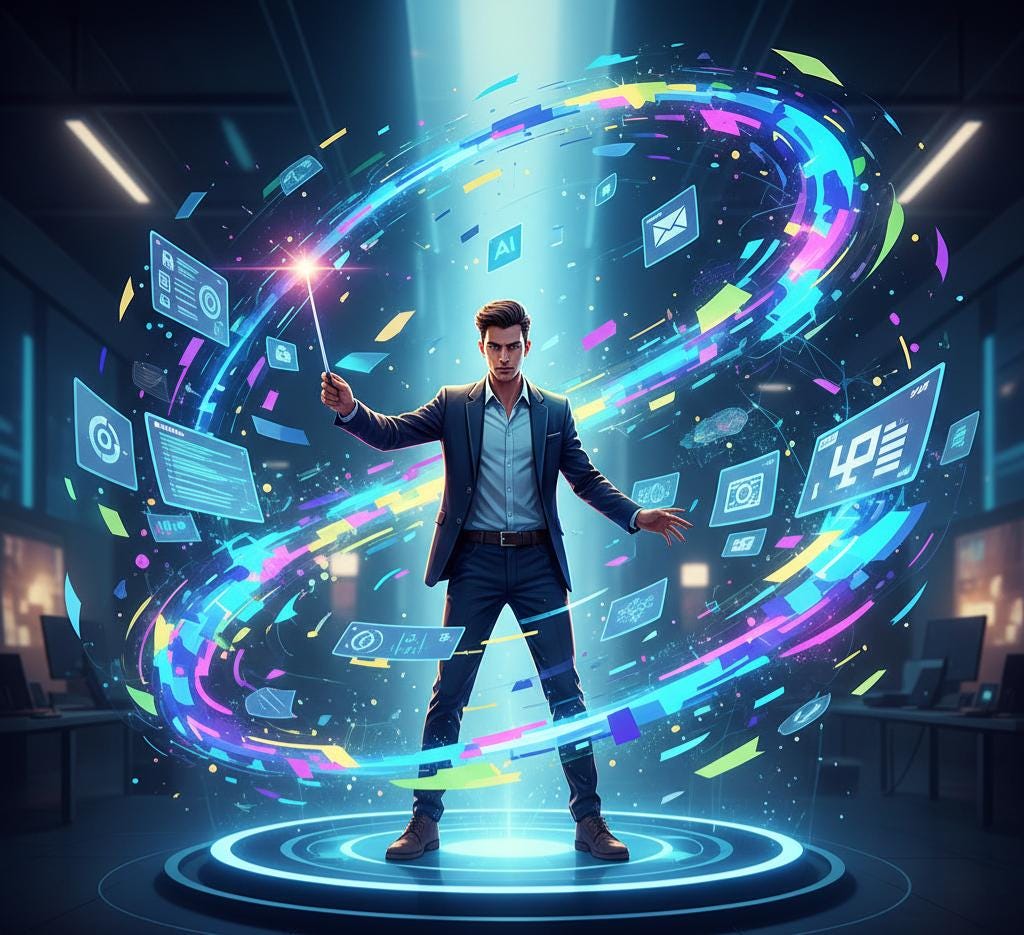
The Human Advantage
If you are worried about AI taking your design job, stop trying to compete with it on speed or volume. You will lose.
Instead, double down on the things AI is terrible at.
AI cannot sit in a stakeholder meeting and read the room to understand the unspoken political dynamics blocking a project. AI cannot conduct a user interview and notice the subtle hesitation in someone’s voice that reveals a hidden pain point. AI cannot take a daring, counter-intuitive creative leap that defies logic but captures emotion.
The future of design isn’t human or AI. It is human plus AI.
The designers who will thrive are those who treat AI not as a threat, but as a tireless junior designer that needs strong direction. Embrace the tools, speed up your workflow, and use the saved time to be more strategic, more empathetic, and more human.
Thanks for reading!
I hope this article gave you a fresh perspective on how we can coexist — and thrive — alongside our new AI tools. The landscape of design is changing fast, but our creativity remains the constant.
If you found value in this breakdown, please give it a round of claps 👏 (did you know you can hold the clap button down to give up to 50?)
And if you want more insights on the intersection of Design, AI, and the future of creative work, hit that [Follow] button. I’ve got a lot more to share soon.
See you in the next one!
……
💡 Stay inspired every day with Muzli!
Follow us for a daily stream of design, creativity, and innovation.
Linkedin | Instagram | Twitter


The Augmented Designer: How AI is Quietly Revolutionizing Our Workflow was originally published in Muzli - Design Inspiration on Medium, where people are continuing the conversation by highlighting and responding to this story.