
It was 1845, and the Texas prairie was no place for two soldiers traveling alone. Lieutenant Ulysses Grant and his companion, Lieutenant Benjamin, had fallen behind their group on a return trip to Corpus Christi and were racing against the clock to avoid being reported absent without leave. The territory was unsettled, the grass was tall, and the night was closing in.
Then they heard it.
Out of the darkness came a howling that stopped both men cold. Not a single animal, but a chorus, rising and overlapping from directly ahead. Grant later wrote in his Personal Memoirs that to his ear it appeared there must have been enough of them to devour their party, horses and all, at a single meal. Benjamin leaned over and asked the question that was already forming in both their minds: “Grant, how many wolves do you think there are in that pack?”
Grant, not wanting to seem rattled, deliberately undersold his estimate. “Oh, about twenty,” he replied, very indifferently.
Benjamin smiled and rode on. A minute later they were close enough to see.
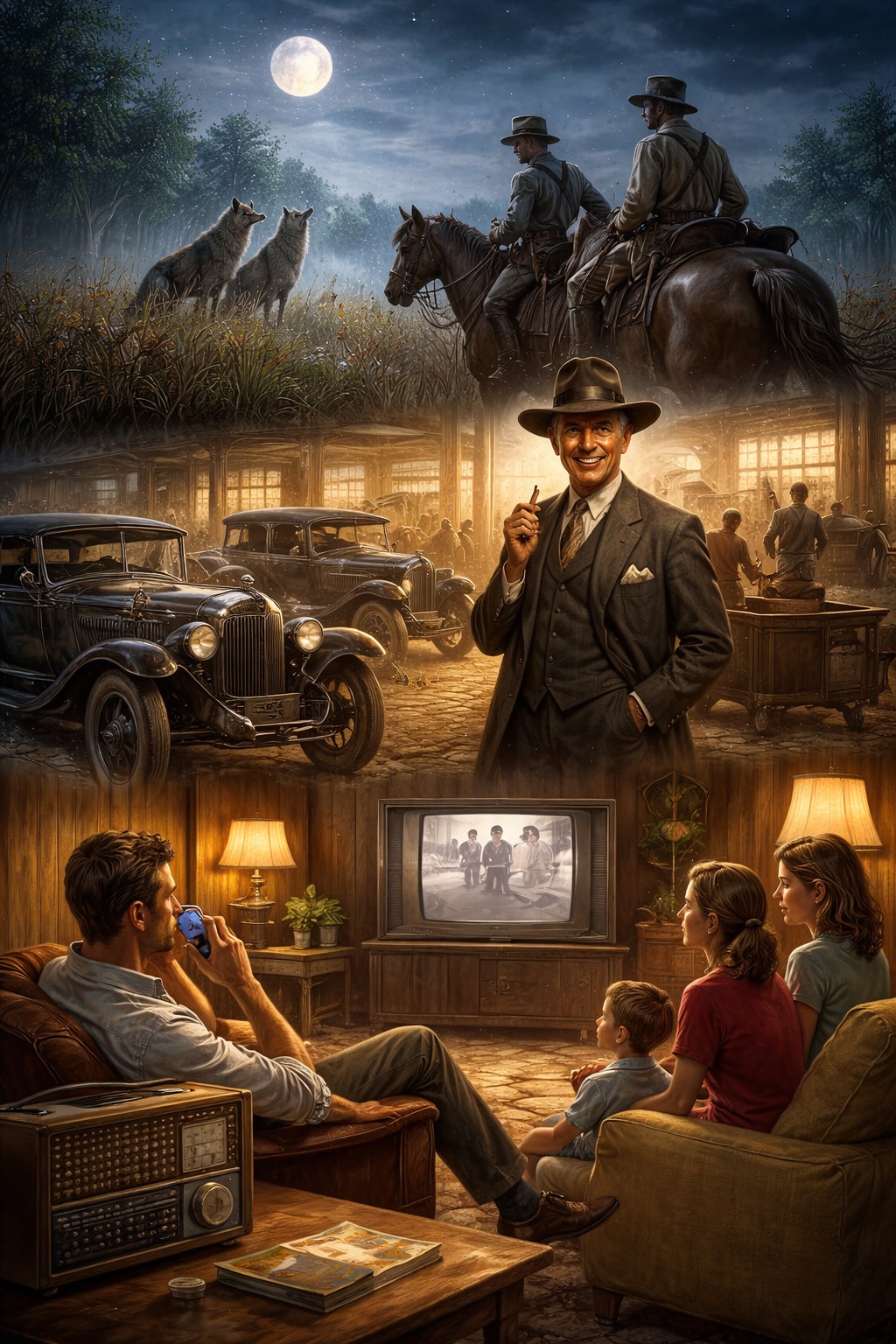
There were just two of them. Two wolves, seated on their haunches with their mouths pressed together, making all the noise that had seemed to announce an entire pack. Grant wrote the moral plainly: “There are always more of them before they are counted.”
He was talking about politicians. But he could just as easily have been talking about the last two years of enterprise software headlines.
This Is Not the First Time Someone Has Declared the End
Before we count the wolves in front of us today, it is worth noting how many times similar howling has echoed through business history, and how many times the obituaries were written prematurely.
In 1890, there were over 10,000 companies in the United States building horse-drawn carriages. By the late 1920s, only about 90 remained. The automobile had arrived, and for most of those 10,000 businesses, the story ended badly. But not for all of them. Some carriage makers did what their industry said was impossible: they pivoted, survived, and in one case, built the largest car company in the world.
William Durant was already wealthy and bored by the time the automobile appeared. He and his partner Josiah Dort had built the Durant-Dort Carriage Company into the largest vehicle manufacturer in the United States, with $2 million in annual sales at the turn of the century. Durant had pioneered vertical integration and multi-brand strategy in the carriage business, and he had turned carriages into aspirational products. He was, in the words of those who knew him, a master promoter and super salesman.
When the automobile arrived, Durant hated them. He thought they were noisy, smelly, and dangerous. According to General Motors’ own historical account, he initially refused to let his daughter ride in one. That position lasted until he actually got behind the wheel of one and recognized the exact same thing he had recognized years earlier in a horse cart at a county fair: an opportunity.
In 1904, Durant was asked to take over the struggling Buick Motor Company. He brought his carriage-era assets with him: the distribution network, the manufacturing relationships, the salesmanship, the instinct for branding across different price points. Within four years, Buick was the best-selling automobile in America, outselling Ford and Cadillac combined. In 1908, Durant used that momentum to incorporate General Motors, consolidating over a dozen car and parts companies into a single holding company. General Motors is still, more than a century later, one of the largest US car manufacturers by volume.
Durant did not just survive a revolution. He led the next one, because he understood that the skills, the systems, and the instincts he had built in the carriage era transferred directly into the new one. He did not abandon what he knew. He drove it straight into a different future.
Now move forward sixty years. In the early 1950s, television arrived in American living rooms and immediately began cannibalizing radio. By 1955, the traditional radio networks were reporting increasing financial losses. Their biggest stars, their most popular programs, their national advertisers: all migrated to the new medium. A 1949 Gallup poll found that nearly half of people who had seen television believed radio was finished. The consensus, inside and outside the industry, was that radio was done.
Radio is still here.
What happened was not that radio ignored television. It adapted by doing something only radio could do: it became portable, immediate, and local. The invention of the transistor radio made the medium mobile. Top 40 formats built around recorded music gave stations a reason to exist that television could not easily replicate. Talk radio and drive-time programming found audiences that wanted audio in their cars and at work, not a screen. By the 1990s, radio advertising revenue had more than doubled in a decade, reaching more than $17 billion annually by 2000. The medium that was supposed to die at the hands of television found a version of itself that television could not touch.
Two different industries, two different eras, same lesson: the threat was real, the transformation was genuine, and most of the survivors did not survive by doing the same thing. They survived by understanding which of their capabilities transferred and which ones did not.
The Bear Case Deserves an Honest Hearing
It is worth being clear about something before we go further: the threat to SaaS is real. Anyone who tells you otherwise is selling comfort, not analysis.
Since early 2026, ETFs tracking public software companies have fallen sharply, erasing gains accumulated since the launch of ChatGPT. Salesforce, Adobe, Intuit, ServiceNow, and others that had compounded investors’ capital for a decade are down significantly in a matter of weeks. The term “SaaSpocalypse” has entered the vocabulary and is, genuinely, not a fringe position.
The structural argument is straightforward. For two decades, the SaaS business model rested on a simple premise: take tasks that humans did manually, automate them into software, and charge per user seat. That model produced extraordinary margins and predictable recurring revenue. AI now threatens both sides of the equation. If AI agents can handle the tasks the software was automating, the case for a dedicated subscription weakens. If building custom software is becoming cheap enough to do in-house, the case for buying someone else’s weakens further.
Marc Benioff, the founder and CEO of Salesforce, stated publicly that his company would not be hiring software engineers in 2025 because AI could handle so much of the work. This is the CEO of one of the world’s largest SaaS companies saying, out loud, that the core input cost of software is collapsing. That is not nothing.
Andreessen Horowitz has been even more direct. Their analysis argues that “software is eating labor,” meaning AI is no longer just automating workflows but replacing the humans those workflows supported. The old playbook of per-seat SaaS pricing, they argue, is being replaced by outcome-based pricing, and incumbents who cannot make that transition without destroying their own economics are in genuine trouble.
So yes. The howling is real. The question is how many wolves there actually are.
Count the Wolves
When Grant and Benjamin rode toward the sound rather than away from it, they were doing something most people in moments of fear do not do: they went to count. Let’s do the same.
The first thing to count is the actual exposure. Not all SaaS is equally at risk, and the market is treating the category as if it were a single undifferentiated mass. It is not. a16z partner Alex Rampell has made this point clearly: the companies most vulnerable are those whose core value is automating tasks that AI can now handle directly, with no proprietary data advantage and no deep workflow entanglement. Those companies face genuine compression. But companies like Workday, ServiceNow, and Veeva sit on years of proprietary, structured, domain-specific data and are embedded into business processes at a level where replacement costs are measured in years of organizational disruption, not months of license fees.
The second thing to count is switching cost, which the market consistently undervalues. Ripping out an ERP system is not a technology project. It is a change management project, a compliance project, a training project, and an integration project all happening simultaneously. Companies that live inside regulated industries, whether healthcare, financial services, or construction, are not going to replace their systems of record with AI agents built on a weekend. The compliance moat is structural, and it does not shrink just because the underlying models get better.
The third thing to count is what actually happened to the incumbents in the previous transition. When cloud computing arrived, the consensus was that on-premise software vendors like Oracle, SAP, and IBM would be wiped out. They were not. They adapted slowly, awkwardly, and with considerable pain, but they retained their enterprise customer bases precisely because those customers were not going to abandon a decade of customization and integration just because a newer delivery model existed. The pattern has every reason to repeat.
The fourth thing to count is where AI is actually winning today versus where the fear assumes it will win. The categories experiencing real disruption right now are, as a16z notes, point solutions with no data moat, no network effects, and per-seat pricing for tasks that are genuinely automatable. Standalone scheduling tools, basic customer service bots, single-use analytics dashboards. These are real casualties. They are not the same as the death of enterprise software.
In the words of Sequoia’s analysis of the current moment, both the software and services profit pools are under attack, and the opportunity is enormous. But the same analysis points out that the greatest value in the AI era will likely be created at the application layer, by companies that own proprietary data, solve complex real-world problems, and build the kind of deep workflow integration that does not disintegrate when a better foundation model ships.
What Changes, and What That Means for You
Here is the part worth considering carefully: the carriage makers who died were not the ones who took the automobile threat seriously. They were the ones who confused “we are not dead yet” with “we do not need to change.”
Radio did not survive by ignoring television. It survived by honestly assessing what it could do that television could not, and then doing more of that. Portability. Locality. Intimacy. The medium found the version of itself that the threat could not touch, and it built there.
Durant did not survive by defending carriages. He survived by asking a different question: which of the capabilities I have built transfer into the new era? His answer turned out to be almost everything that mattered: distribution, brand strategy, multi-product architecture, salesmanship, vertical integration. The vessel changed. The skills did not.
The question for every SaaS leader right now is not “will AI disrupt my category?” It will. The question is which parts of what you have built are genuinely defensible, and which parts were just the easiest path to growth in an era when the cost of intelligence was high enough that automation itself was the moat.
Two questions are worth asking honestly, not in a board presentation but in a room with your product and engineering leads:
If a well-funded team used the best available AI tools for six months, could they build a functionally equivalent product? If the honest answer is yes, that is a problem that needs to be named and addressed, not managed around. If the honest answer is no, the next question is what specifically makes that true, because that is what needs to be protected and extended.
What data does your product generate or hold that has no substitute? This is the question Durant answered without knowing he was answering it. His distribution network, his multi-brand customer relationships, his manufacturing knowledge: none of those lived in the carriages. They lived in the organization. They transferred.
Ride Toward the Sound
Grant and Benjamin did not turn back when they heard the howling. They did not hold an emergency meeting about wolf strategy. They rode toward the noise, got close enough to count, saw two animals instead of twenty, and understood the situation for what it was rather than what it sounded like.
The SaaS apocalypse is not a fiction. The threat is real and some companies will not survive it, specifically the ones that are counting on the same business model they had in 2019 to protect them through 2030. But the pack is smaller than the howling suggests, and the companies that will come out of this transition are not the ones that ignored it or the ones that panicked into incoherence.
They will be the ones that rode towards the sound, counted the actual wolves, and built from what they found.