
Welcome to the 1,481 newly Not Boring people who have joined us since our last essay! Join 265,556 smart, curious folks by subscribing here:
Hi friends 👋 ,
Happy Wednesday! Last week, I went out to LA to give a talk at my friend Grant Gittlin’s event, The Mountain. He asked me to do something different and weird, and I took the opportunity to pull a bunch of the ideas I’ve written in essays like Means and Meaning, The Company as a Machine for Doing Stuff, The Return of Magic, Most Human Wins, and others into one cohesive ~philosophy. It was a good excuse to think about the meaning of life.
This is the talk. It was written to be spoken, so it may seem an oddly-written essay, but I hope it’s useful nonetheless, if for no other reason than that it makes you pause and wonder at the insane gift and responsibility we’ve all been given to experience and create in the world from our own unique points-of-view.
I was very nervous giving this talk to a room full of 80 people, but once I got through that, and a bunch of people told me that I should share it more broadly, I decided why not send it to 265,556 of my closest friends. I do think a lot of people are wondering what it is we’re here to do when machines can do more and more.
This is my best attempt yet, in what will be a lifetime full of attempts, to answer that question and then try to live the answer.
Let’s get to it.
Note: I’m sharing the first half with everyone and the whole thing with not boring world subscribers. Join us.
Riding the Leopard
Transcript of a Talk Given at The Mountain on May 6, 2026
Thanks for inviting me, Grant, and to all of you for letting me fill your experience and attention for a little while.
What a week to get to talk to a room of technology people. Sierra just raised at $15 billion. Anthropic crossed a $44 billion run rate, and launched a new company with some huge funds that has $1.5 billion to deploy AI in big companies. OpenAI did the same thing but with $4 billion. Long Lake bought AmEx global travel for $6.3 billion.
All of which raises an important question: who gives a shit?
I mean that: why do we care?
Things are moving so fast that it’s worth thinking about what it is that we’re doing here.
Last night, a woman who reads my newsletter reached out over Substack DM. She said she had been diagnosed with Stage IV cancer (she’s in remission now!), so she had been confronted with a question we’d all be facing: what happens to human purpose when AI removes scarcity (or in her case, the need to care about being productive at all)? To answer it, she analyzed more than 200 sci-fi books. Across all of those books, by far the most common thing left to solve for post-scarcity is meaning. 59% of books were about the search for meaning. Identity was next, at just 17%.
Assume that companies will keep getting bigger and bigger, and growing faster and faster, and who cares… the thing we’ll be left solving for is meaning.
Luckily, that’s what I’d been planning to talk to you about.
When Grant asked me to talk and I asked Grant what he wanted me to talk about, he said, basically, “Whatever you want, the weirder the better. The line I really love from your recent essays is ‘You have the right to the work only but never to its fruits. Let not the fruits of action be your motive, nor let your attachment be to inaction.’”
The funny thing about that line, which comes from the Bhagavad Gita, is that when I wrote about it, Venkatesh Rao, who is smarter, better read, and more Indian than me, replied, “This interpretation of the Gita verse is a bit of a stretch.”
After going back and forth in the comments, I think Venkatesh and I actually agree, but I am warning you that I am going to do a little bit more Indian-text-stretching and leaping in this talk to build a framework that I think is potentially useful and give it some ancient gravitas.
There is this category of questions I’ve been wrestling with, which I think a lot of people have been wrestling with recently, which is something along the lines of:
If new technology is so great, why are so many people unhappy?
If we have means our ancestors couldn’t have dreamed of, why is there a meaning crisis?
What is technology for, anyway? What are we doing here?
In his 1978 essay collection, The Unheard Cry for Meaning, Holocaust survivor Viktor Frankl wrote, “The truth is that as the struggle for survival has subsided, the question has emerged: survival for what? Ever more people today have the means to live but no meaning to live for.”
Frankl, who wrote Man’s Search for Meaning about his experience finding meaning in the concentration camp, in the worst situation imaginable, writes three decades later about the lack of meaning in what could historically be described as the best situation imaginable.
This weird inverse relationship between material and spiritual wealth shows up over and over again.
“Again I tell you,” preached Jesus, “it is easier for a camel to go through the eye of a needle than for a rich person to enter the kingdom of God.”
The greater our means, the harder it might be to find meaning. The more we accomplish, the sooner we ask, “Cool, now what?”
It seems that we are in the middle of creating more technological, financial, and material wealth than we have at any other point in human history, thanks in part to some of the people in this room.
In order to avoid being the proverbial car-catching dogs, we’d better get prepared for what lies on the other side of all of those means. The world’s spiritual traditions were formed in times of scarcity. How are we supposed to handle all of this abundance? Is abundance bad, actually?
I’m going to propose a framework, drawing loosely on a broad set of sources including, but not limited to, the world’s major religions and a guy who took a lot of acid.
Here’s what I propose:
The meaning of life is to increase the range and depth of experience in the universe.
OK, so for the first stretch.
In the Upanishads, there is this concept of “Neti, neti,” or “Not this, not this.” It is a process of understanding what we are not so we can better understand what we are.
When you sit in silence and make yourself observe yourself, you notice things like:
“I am not my thoughts, because I can observe them come and go.”
“I am not my emotions, because I can watch them rise and fall.”
“I am not my bodily sensations, because I can feel them changing.”
The idea is to strip all of that away so that you know, gnostically, in your bones, that “you” are a process, an undefinable part of an incomprehensible whole. Which doesn’t mean that you are nothing.
What’s left is awareness, and at any moment, awareness is aware of something, experiencing something. You are awareness itself, and if you’ll allow me to stretch one step further, you are what you experience.
This probably isn’t a coincidence. Experiencing things might be the whole reason we’re here.
A few years ago, I started going down this rabbit hole that sounds insane when you list it out, from Dan Simmons’ sci-fi series Hyperion Cantos to Jesuit scholar Pierre Teilhard de Chardin’s The Phenomenon of Man to The Telepathy Tapes to The Perennial Philosophy, Aldous Huxley’s book arguing that mystics in every tradition – Christian, Hindu, Buddhist, Sufi, Taoist – have peered deeply into the nature of reality and come back saying basically the same thing.
The same thing is: thou art that.
This is a phrase that comes from the Upanishads, too. The idea is that the innermost self in you (Atman) and the ultimate reality of the universe (Brahman) are not separate things but the same thing.
If I am not my thoughts, not my emotions, not my body, what am I? Thou art that.
You are god, the universe, whatever, looking at itself through a particular set of eyes, experiencing itself through a particular consciousness.
If this is true, and it’s at least weird that so many of the world’s religions came to the same conclusion!, it means that every unique experience a human has is the universe experiencing itself in a way it couldn’t have otherwise.
This idea is both woo-sounding and load-bearing for the rest of the talk, so I’m going to reinforce it a little bit through some good ol’ fashioned appeal to authority.
Alan Watts said that “‘You’ is the universe looking at itself from billions of points of view, points that come and go so that the vision is forever new.”
The 13th Century Sufi Poet Rumi said, “You are not a drop in the ocean, you are the entire ocean in a drop.”
The Jesuit de Chardin said something similar. He held the heretical belief that evolution had a direction, towards more complexity, consciousness, and interiority. He asked, “What is the worth of human works if not to establish, in and by means of each one of us, an absolutely original center in which the universe reflects itself in a unique and inimitable way?”
I can see that you want to get weirder. Let’s get weirder.
Chris Bache, a Professor Emeritus in Philosophy and Religion at Youngstown State University, conducted 73 high-dose LSD sessions on himself over the course of twenty years, going deeper and deeper, often painfully, to the point of tears and vomit, each time. From his later sessions, when he was getting really deep, he came back with the knowledge that “the essence of the individual is the essence of Totality, that Atman is Brahman.”
He portrays humans as incarnated aspects of a Creative Intelligence whose purpose is to awaken within physical existence, exercise controlled creativity, and thereby participate in the universe’s self-emergence.
Too weird? Let’s re-anchor on someone more traditionally credible.
Alfred North Whitehead, the mathematician who wrote Principia Mathematica with Bertrand Russell, spent his 60s building a metaphysics from scratch. “With the becoming and perishing of each actual occasion,” he wrote of moments, “a perspective on the universe is achieved that has never existed before.” In Whitehead’s metaphysics, the universe is not made of things, but of, and I quote, “drops of experience.”
So far, we have religious mystics of all traditions, a philosophical entertainer, a psychonaut, and a mathematician staring deep into the universe and reporting back essentially the same thing.
Why, though? If we are slivers of the universe experiencing itself, to what end?
Because through our imperfect experience, an infinite and perfect universe can know itself and create itself.
A couple of years ago, a podcast called The Telepathy Tapes rocketed to #1 on the podcast charts. The host, Ky Dickens, had heard stories of non-verbal autistic kids who were able to communicate telepathically, and on the podcast, she interviewed a lot of them and their parents and ran experiments to test their abilities.
The thing that got me was a conversation with one of the kids, named Asher, who said, through a verbal woman named Jess, that he visits a place called the Realms to access information on any topic, which sounds crazy except for the fact that the kids know things about people they’ve never met that they couldn’t possibly know, and understand languages they were never taught and which their parents don’t speak.
Explaining the Realms, Asher said:
It’s all parts of our soul exploring consciousness in different ways, and we’re basically building up huge amounts of information.
Every new thought we have, every new idea we have is new information. And that way, we’re expanding the cosmos because each new piece of information that we come up with then goes into this library of his and becomes available for everybody else. But we have to get this knowledge through direct experience in 3D life.
This is something that comes up again and again, too: that God or the universe, omniscient and omnipotent as it is, needs imperfect beings to experience things to sample the full range. There are no stakes if you know how things will play out, no sacrifice if you can just fix it.
There’s this great book by William Egginton called The Rigor of Angels: Borges, Heisenberg, Kant, and the Ultimate Nature of Reality, in which the author examines the ultimate nature of reality from the perspective of the author, the quantum physicists, and the philosopher. All three came to the same conclusion:
To observe anything, you need distinctions — between here and there, before and after, this and that. Without those gaps, there’s nothing to observe. A timeless, spaceless, perfect unity would be unobservable. Perfection can’t know itself. Only finite, imperfect conditions make experience possible.
Our job, then, cosmically, is to be limited, imperfect things having experiences on behalf of something too perfect and limitless to be able to.
Which was kind of the point of Jesus, right? Christianity’s deepest claim - that God became man, the infinite became finite - is the same claim the other traditions are making, from a different angle.
Jesus even had his own version of thou art that: “The Kingdom of God is within you.”
In the Gospel of Thomas, discovered at Nag Hammadi in 1945, Jesus says, “If you bring forth what is within you, what you have will save you. If you have nothing within you, what you do not have within you will kill you.” Interpretations range from the gnostic - if you recognize and bring forth the divine light within, you will return to source - to the psychological.
This quote is famous today because Jung’s followers use it to explain the concepts of Shadow and Individuation. “If you bring forth what is within you…” refers to Individuation, or the process of taking the hidden parts of your personality, your talents, your repressed emotions, your Shadow, and bringing them into the light of consciousness. By becoming fully and uniquely you, you are saved from living a fake life.
“The privilege of a lifetime,” Joseph Campbell said, “is being who you are.” You’ve probably heard that one before. It comes from In the Field, the opening of Reflections on the Art of Living: A Joseph Campbell Companion, something that I highly recommend everyone read. What I forgot until I looked it up while writing this talk was what he said later in that essay.
Where there is a way or path,
it is someone else’s path.
You are not on your own path.
If you follow someone else’s way,
you are not going to realize
your potential.
Eternity
is a dimension
of here and now.
The divine lives within you.
And later still:
The goal of the hero trip
down to the jewel point
is to find those levels in the psyche
that open, open, open,
and finally open to the mystery
of your Self
being Buddha consciousness
or the Christ.
That’s the journey.
It’s all about finding
that still point in your mind
where commitment drops away.
The separateness
apparent in the world
is secondary.
Beyond that world of opposites
is an unseen (but experienced)
unity and identity in us all.
And then:
You must return
with the bliss
and integrate it.
The return is seeing
the radiance everywhere.
The goal is to live
with godlike composure
on the full rush of energy,
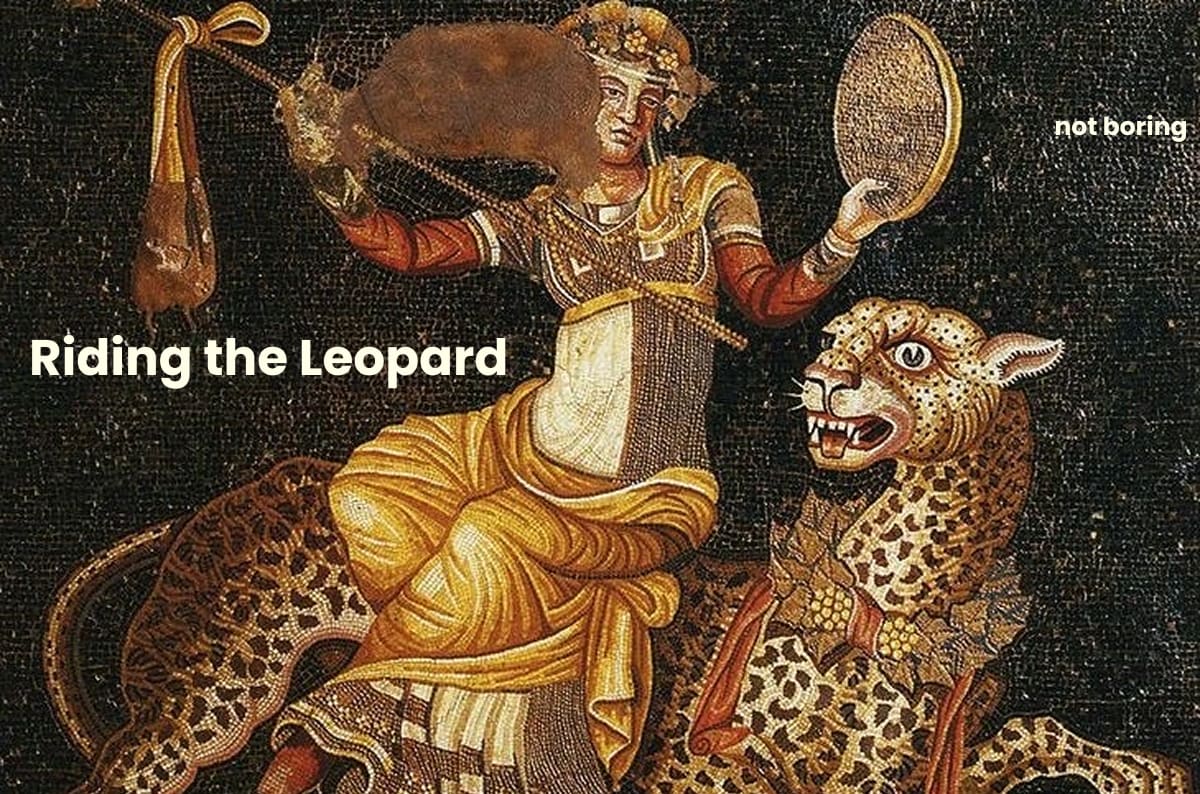
like Dionysus riding the leopard,
without being torn to pieces.
Which is one of the coolest lines I’ve ever read, and if you take just one thing from that talk, I hope it is that: to live with godlike composure on the full rush of energy, like Dionysus riding the leopard, without being torn to pieces.
This is a man who spent his entire life studying the stories and myths that humans across space and time have told ourselves to understand ourselves, and he came back reporting the same thing.
Thou art that. Thou must be the specific version of that you were put here to be.
Every one of these people is saying the same thing: you are a piece of the universe experiencing itself. And every one of them is saying, in different words, that this imposes an obligation on you: to be the fullest, strangest, most irreducible version of yourself. All of this so that each of us might create and experience the world differently than anyone else could.
In other words, differentiation is a moral obligation.
It is also a mathematical one, and here I will bring this room full of technologists back to familiar ground.
In his 1948 “A Mathematical Theory of Communication,” Claude Shannon, the founder of information theory and the originator of the word ‘bit,’ proved mathematically that information is surprise.
The more predictable a message is, the less information it contains. A universe full of identical people producing identical experiences would contain no information at all.
An omniscient god cannot be surprised.
It’s only through the surprising, the differentiated, the irreducibly specific, that any new information enters the system. Shannon was in no way intentionally writing about the meaning of life, but if you take his math seriously, and mix it in with the mystics and philosophers’ message, the universe learns something through you only to the extent that you are the unexpected thing only you could be.
Forty years later, John Wheeler, the physicist, re-enchanted Shannon’s concept of the bit when he proposed the now-famous “It from Bit” at a conference in Tokyo. In Wheeler’s Participatory Universe, the universe doesn’t exist until it’s observed by a conscious mind. Matter (It) emerges from information (bit).
Wheeler wasn’t a kook. He was a giant. Richard Feynman, his most famous student, said “Some people think Wheeler’s gone crazy in his later years, but he’s always been crazy.” Feynman credited Wheeler’s insights as the foundation of the Quantum Electrodynamics that won him the Nobel Prize.
CalTech’s Kip Thorne, another Nobel Laureate Wheeler protege and the physics consultant on Interstellar, said that “Wheeler was the greatest master of metaphors and names I have ever known.” He came up with Black Hole and Wormhole and Quantum Foam. Thorne called him “the last of the giants.”
And Wheeler argued that humans are co-creators of the universe, through the surprising actions we take and the things we experience.
OK, so having stretched and mixed a bit, where are we?
You are not your job, your outfit, your emotions, your body. You are awareness. You are a little slice of the universe experiencing itself.
Christians, Buddhists, Hindus, psychonauts, non-verbal autistic children, and myths from around the world that the meaning of life is to expand the range and depth of experience in the universe in order to expand and co-create it.
You are here to experience and create in a way that only you can, and for many of you in this room, that means experiencing and creating in a way that expands humanity’s capacity for experience and creation. Differentiation is a moral obligation.
If some of this sounds familiar, it might be because it sounds very similar to how we train AI models. Humans take actions and create information, from which the model learns and grows. Labs are willing to pay a ton of money for new information; feeding it the same old stuff actually degrades performance.
So where does that leave us, the humans in the room?