
The 2003 Northeast blackout wasn’t just “trees hit power lines”; it was a textbook case of what happens when you don’t red-team your monitoring, your assumptions, and your failure modes.
Around 2:15 p.m. on a hot August afternoon, the grid was already failing, but the people responsible for saving it had no idea their alarms had gone dark.
What Happened
On August 14, 2003, a high-voltage transmission line in northern Ohio sagged into overgrown trees and tripped offline. By itself, this was a routine fault, the kind that happens regularly on large power grids and is normally contained without customers ever noticing. But inside FirstEnergy’s control room, something far more dangerous was unfolding.
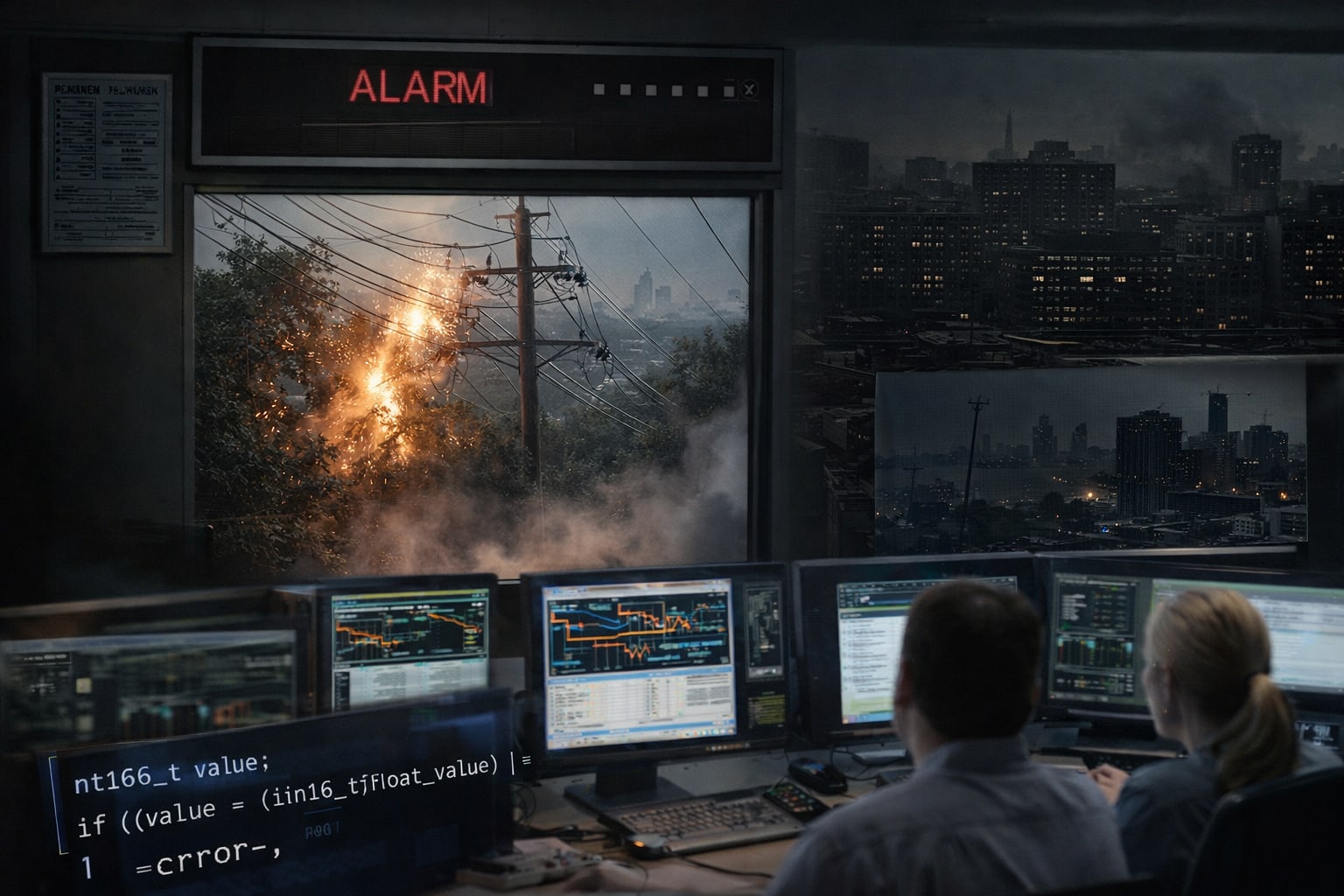
A software problem in FirstEnergy’s Energy Management System caused the alarm function to stop updating. Operators did not receive audible or visual alerts as additional lines overloaded and tripped. Worse, the system provided no clear indication that the alarm processor itself had failed. From the operators’ perspective, things looked quiet, deceptively quiet.
As additional transmission lines went out of service, power flows rerouted automatically onto remaining lines. Those lines overheated, sagged further into trees, and tripped in turn. Protective relays did exactly what they were designed to do: remove stressed equipment to prevent physical damage. But each correct local action pushed the broader system closer to collapse.
For over an hour, the grid drifted into an increasingly unstable state while the humans responsible for intervening lacked accurate, real-time situational awareness. By the time the failure cascaded beyond Ohio, it was too late to contain. Power outages rippled across the interconnected system, ultimately cutting electricity to roughly 55 million people across the U.S. Northeast and parts of Canada.
Post-incident investigations emphasized a sobering truth: the initiating events were not exotic. There was no cyberattack, no unprecedented weather, no single dramatic failure. The catastrophe emerged from a chain of ordinary weaknesses, inadequate vegetation management, insufficient real-time visibility, and organizations that had never fully reckoned with what “loss of alarms” actually meant.
The U.S.–Canada Power System Outage Task Force’s final report documents this sequence in detail, including the failure of the alarm processor and the resulting loss of operator awareness.
The Alarm Failure No One Was Watching For
It is tempting to describe the 2003 blackout as a physical infrastructure problem. Trees did contact power lines. Transmission corridors were inadequately maintained. But those conditions existed long before August 14. What made that day different was that the grid’s nervous system went numb.
FirstEnergy’s Energy Management System relied on a software component responsible for detecting abnormal conditions and notifying operators through alarms. That component failed silently. Operators were not alerted when it stopped working, nor were they trained to recognize the subtle signs that their alarm system was no longer trustworthy.
Scientific American’s account of the blackout describes how the alarm system failed on that first line trip, and how over the following hour and a half, operators tried to understand what was happening as three more lines sagged into trees and switched off one by one. The system did not announce its own collapse. It degraded quietly, each failure invisible to the people responsible for stopping it. Quiet failures are the most dangerous kind.
Why This Was Not a Knowledge Problem
One of the most important conclusions of the task force was that this was not a failure of competence. Grid operators knew how to run a power system. Engineers understood load flows and contingencies. The rules for preventing cascading failures were well documented.
What failed was the assumption that the instrumentation, the alarms, displays, and indicators, would always be there to tell operators when they were in trouble. The system was designed to handle equipment failures. It was not designed to handle awareness failures.
When alarms stopped updating, there was no explicit “this system is lying to you” signal. No prominent health indicator. No practiced drill for “our alarms are dead.” The absence of alarms was interpreted as the absence of problems, exactly the wrong inference.
Wikipedia’s overview of the event highlights this point succinctly, noting that the alarm processor failure went unnoticed for over an hour while conditions deteriorated. This distinction matters deeply, because it reframes the incident from “operators missed something” to “the system failed to degrade safely.”
Red-Teaming the Wrong Thing
Organizations are generally comfortable red-teaming their plans. They stress-test strategies, forecast demand, model failure scenarios, and ask what happens if a particular component breaks. What they do far less often is red-team the instrumentation they rely on to know whether those plans are working.
The 2003 blackout is red-teaming in the most literal sense. The grid did not fail because no one knew how to operate it. It failed because the operators’ information system failed, and no one had rehearsed that possibility. This is a lesson that translates cleanly to product management and leadership.
Dashboards, alerts, KPIs, uptime monitors, customer feedback loops, these are the alarm systems of modern organizations. Leaders make decisions based on the assumption that when something is wrong, they will know. Product teams assume that regressions will surface through metrics. Executives assume that if a chart is green, things are fine. But what if the chart is wrong?
What if the alerting pipeline is broken, the data is stale, the metrics are lagging, or the signal is drowned in noise? Do teams notice quickly? Or do they, like the grid operators in 2003, interpret silence as safety?
The Northeast blackout demonstrates that losing observability is not just another failure mode. It is a meta-failure, one that disables your ability to respond to every other failure.
When Metrics Become the Alarm System
In modern product organizations, dashboards are the control room. We rely on metrics to tell us whether users are happy, whether systems are healthy, whether teams are performing, and whether strategy is working. Conversion rates, latency percentiles, churn, engagement, NPS, velocity, uptime, these numbers become proxies for reality. When they move, we react. When they’re flat, we assume stability. This is where the 2003 blackout becomes uncomfortably familiar.
The grid operators that afternoon were not ignoring data. They were looking at it constantly. The problem was that their alarm system, the very mechanism designed to surface danger, had failed silently. The absence of alerts was interpreted as the absence of problems. Silence became reassurance. Product teams fall into the same trap.
If dashboards aren’t flashing red, leaders assume things are under control. If metrics are green, they infer health. But metrics are not reality, they are an instrumentation layer, and like any instrumentation, they can be incomplete, misleading, delayed, or broken. This is where the old management adage begins to crack.
The phrase “If you can't measure it, you can't manage it” is often attributed to Peter Drucker, but according to the Drucker Institute, he never said it. It is also frequently misattributed to W. Edwards Deming, though Deming actually wrote the opposite: “It is wrong to suppose that if you can't measure it, you can't manage it, a costly myth.” The truncated version, stripped of its context, inverts Deming's actual point entirely.
Another quote often misattributed to Drucker is “What gets measured gets managed.” Drucker never said it either. The idea actually originates with V.F. Ridgway's 1956 paper Dysfunctional Consequences of Performance Measurements, in which Ridgway warned against the indiscriminate use of quantitative measures. Journalist Simon Caulkin later captured the spirit of Ridgway's argument in a phrase that has stuck: “What gets measured gets managed, even when it's pointless to measure and manage it, and even if it harms the purpose of the organization to do so.” In other words, measurement is powerful, and dangerous.
When product leaders equate what they can see with all that matters, blind spots become inevitable. Teams optimize for metrics that are visible while quietly accumulating risk in areas that are harder to quantify: team burnout, customer frustration that hasn’t yet surfaced as churn, growing operational fragility, cultural erosion, or decision latency caused by process overhead.
Just as critically, teams rarely ask a harder question: How would we know if our metrics stopped telling the truth?
Blind Spots, Silent Failures, and the Illusion of Control
The most sobering lesson from the Northeast blackout is not that alarms failed, it’s that no one was prepared for what that meant. The grid was designed to handle line failures. It was not designed to handle awareness failures. There was no practiced response for “our view of the system is wrong.” By the time operators realized they were blind, the cascade was already irreversible. In product organizations, blind spots emerge in similar ways.
Instrumentation often reflects what is easy to measure rather than what is important. Teams measure feature usage but not user confusion. They track velocity but not rework. They monitor uptime but not the operational load on engineers maintaining it. They survey engagement annually and call it culture. These gaps don’t announce themselves. They compound quietly.
Even more dangerous is when teams don’t notice that their instrumentation has degraded. Metrics become stale. Alerts are tuned out due to noise. Dashboards remain green because thresholds were never updated as the system evolved. Leaders believe they are informed, when in reality they are flying on partial instruments. This is the modern equivalent of the silent alarm.
Product leadership, like grid operation, is not just about making good decisions. It is about knowing when your ability to make good decisions has been compromised. That requires explicitly red-teaming not just your strategy, but your sensing mechanisms.
If user behavior changes in ways you’re not measuring, would you know?
If team morale deteriorates gradually, where would that show up?
If productivity looks stable but innovation slows, which metric would catch it?
If your dashboards went dark tomorrow, or worse, confidently wrong, how long would it take you to notice?
These questions are uncomfortable, which is precisely why they matter.
The blackout did not happen because people were careless. It happened because the system created a false sense of control. Modern product organizations face the same risk when metrics become substitutes for judgment rather than inputs to it.
The lesson is not to abandon measurement. It is to treat measurement as a fallible system, one that needs redundancy, skepticism, and regular challenge. Metrics should provoke questions, not end them. Silence should raise suspicion, not confidence.
Because when the alarm goes silent, the failure is already underway, and the longer you trust what you can see, the harder it becomes to recover from what you can’t.