Content note: This article discusses deaths on Mount Everest, including descriptions of bodies that remain on the mountain. While these stories serve as metaphors for business leadership lessons, readers sensitive to discussions of death and human remains may wish to proceed with awareness.
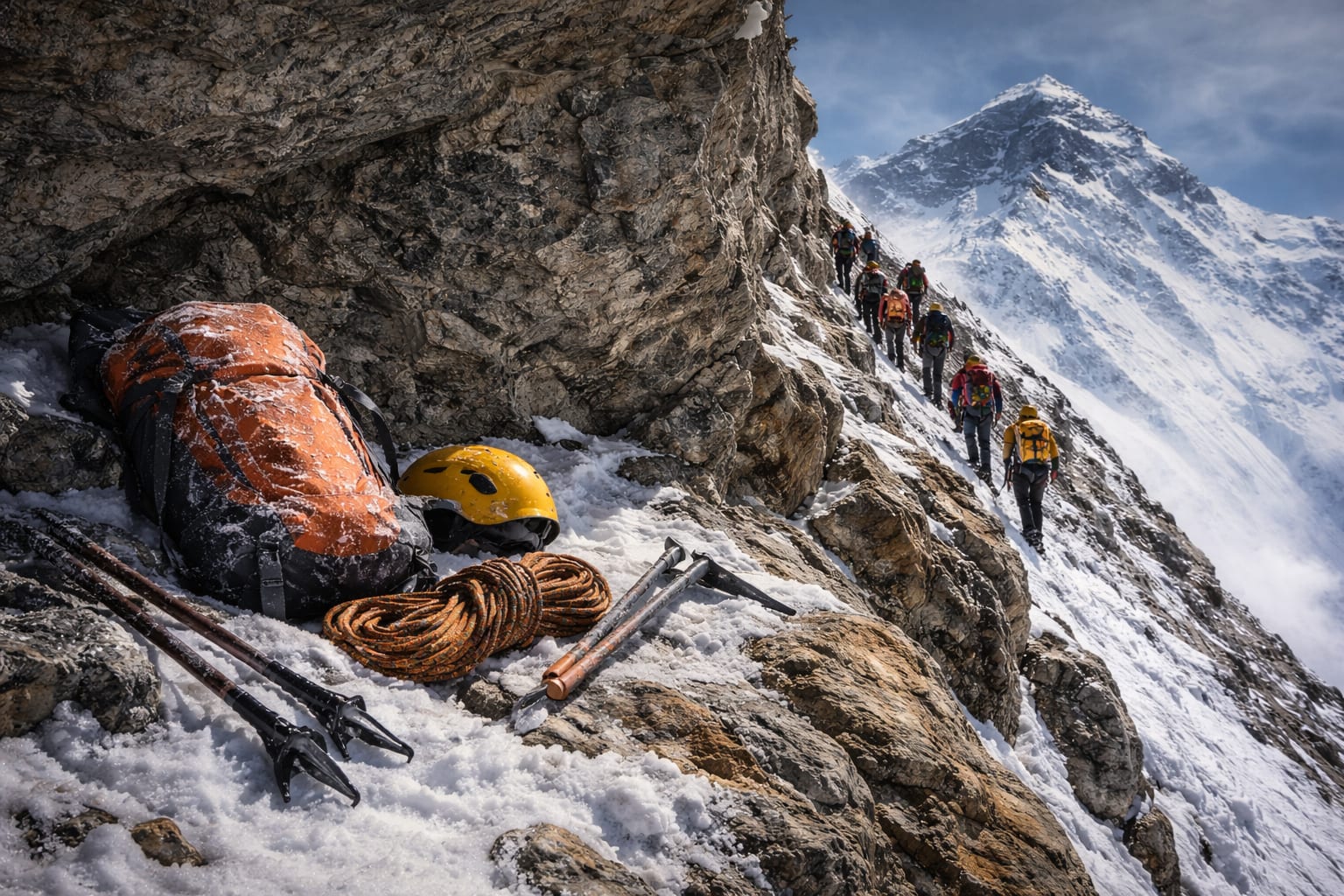
At 27,900 feet on Mount Everest’s Northeast Ridge, there’s a small limestone cave that every climber ascending from the north side must pass. Inside, curled in a fetal position, lies a body wearing bright green Koflach mountaineering boots. For nearly two decades, thousands of climbers trudged past this spot, using it as a navigational landmark. Some paused to catch their breath. Others took photos. Most simply noted the location and kept moving toward the summit.
The body is widely believed to be Tsewang Paljor, a 28-year-old Indian climber from the Indo-Tibetan Border Police. On May 10, 1996, Paljor and his teammates were caught in a blizzard just short of the summit. His team radioed that they had reached the top, but they never made it back down. Paljor sought shelter in this alcove, where exposure and oxygen deprivation claimed his life. His green boots, remarkably preserved in the thin, cold air, became his defining feature, and his legacy. The true identity of the climber has never been officially confirmed, which in its own way deepens the lesson.
Green Boots became more than just a body on Everest. He became a cautionary tale. A warning. A permanent reminder that ambition without judgment can leave you frozen in place, serving as someone else’s lesson about what not to do.
In business, we have our own Green Boots. Companies and leaders whose failures are so visible, so instructive, that they become case studies in MBA programs and cautionary tales in boardrooms. WeWork. Theranos. FTX. These aren’t just failures, they’re landmarks. Permanent markers of hubris, poor judgment, and the catastrophic consequences of ignoring warning signs.
The question every leader must ask isn’t whether you’ll face adversity or make mistakes. You will. The question is whether your failures will become footnotes in your learning journey, or whether they’ll become permanent warnings to others about what happens when ambition eclipses wisdom.
When Ambition Becomes Warning
Not every failure becomes a cautionary tale. Most mistakes are private, corrected quietly, learned from internally. But some failures are so spectacular, so visible, that they transcend the individual or organization and become permanent teaching tools for others.
What transforms a failure into a cautionary tale? Three elements converge.
Visibility. The failure happens in full public view, impossible to ignore or sweep away. Green Boots lies directly on the climbing route. WeWork’s implosion played out in business headlines globally. Theranos’ fraud trial captivated the nation. These failures couldn’t be hidden.
Preventability. In hindsight, the warning signs were visible to others. Multiple people raised concerns. The conditions demanded retreat. But the leaders pressed forward anyway, driven by summit fever, overconfidence, or willful blindness.
Permanence. The failure becomes a teaching tool, cited repeatedly to justify caution. “Remember what happened to…” becomes the opening line of every objection to bold action.
WeWork: Growth Without Economics
At its peak in 2019, WeWork was valued at $47 billion, fueled by Adam Neumann’s vision of redefining not just office space but human consciousness itself. The company burned $2 billion annually with no clear path to profitability. Neumann treated WeWork as his personal treasury, buying buildings and leasing them back to the company at a premium, trademarking “We” and charging millions for its use, taking out interest-free loans, and flying on private jets while the company hemorrhaged cash.
The business model was fundamentally flawed. WeWork was a landlord with long-term lease obligations and short-term tenant commitments, dressed up as a tech company to justify tech valuations. When the IPO prospectus revealed the financial reality, the valuation collapsed by 80% in weeks. Neumann was ousted. Thousands lost their jobs.
The lesson: Growth without governance is a house of cards. Unit economics matter. No amount of charisma or vision can substitute for a viable business model. WeWork is now taught in business schools as a cautionary tale about conflating hypergiant funding with sustainable growth.
Theranos: Fake It Till You Make It in Healthcare
Elizabeth Holmes promised to revolutionize blood testing with technology that could run over 240 tests from a single drop of blood. At its zenith, Theranos was valued at $9 billion. Holmes graced magazine covers, was compared to Steve Jobs, and assembled a prestigious board including Henry Kissinger and James Mattis.
There was just one problem: the technology didn’t work. The machines couldn’t perform the tests as advertised. Most blood samples were tested on traditional equipment purchased from Siemens. Results were often inaccurate, potentially endangering patients. When Wall Street Journal reporter John Carreyrou began investigating, he uncovered a culture of fear where whistleblowers were threatened with lawsuits and employees were fired for raising concerns. This eventually led to his book Bad Blood: Secrets and Lies in a Silicon Valley Startup.
Holmes multiplied the voting rights of her shares to give herself 99% of total voting control, making it functionally impossible for the board to intervene even after some members learned of the deception. She leveraged the “fake it till you make it” mantra of Silicon Valley, but applied it to medical devices with life-or-death implications.
In 2022, Holmes was convicted of criminal fraud and conspiracy to commit fraud. She received an 11-year prison sentence. Theranos dissolved, leaving investors with total losses and patients with potentially harmful medical advice based on faulty test results.
The lesson: Charisma cannot substitute for substance. Governance structures that concentrate power prevent accountability. In industries where safety matters, healthcare, financial services, infrastructure, cutting corners isn’t just unethical, it can become criminal. The “move fast and break things” ethos has limits.
FTX: The House Built on Vapor
In November 2022, cryptocurrency exchange FTX collapsed practically overnight, wiping out $8 billion in customer funds. Founder Sam Bankman-Fried had built FTX into the second-largest crypto exchange in the world, with a valuation of $32 billion. He cultivated an image as the responsible adult in the wild west of crypto, living modestly and pledging to give away his fortune.
Behind the facade lay catastrophic governance failures. FTX had no board of directors for the first three years of its existence. Critical business decisions were documented via Slack, Signal, and Telegram, ephemeral messaging systems that leave no audit trail. Customer funds were commingled with Alameda Research, Bankman-Fried’s trading firm, and used for high-risk trades without customers’ knowledge or consent.
When customers rushed to withdraw their funds, FTX couldn’t meet the demand. The house of cards collapsed. Bankruptcy proceedings revealed what the court-appointed CEO called “a complete failure of any internal controls or governance whatsoever.”
Bankman-Fried was convicted on seven counts of fraud and conspiracy and sentenced to 25 years in prison. Customers lost billions. Employees lost their jobs. The crypto industry’s reputation sustained yet another devastating blow.
The lesson: Regulatory gaps don’t excuse fundamental fiduciary duties. Even fast-moving, innovative companies require basic governance structures. Trust without verification is negligence. The absence of adult supervision invites disaster.
The Warning Signs Before You Become the Warning
These three companies didn’t fail suddenly. The warning signs were visible for years. People inside and outside the organizations raised concerns. But the leaders pressed forward, driven by summit fever, convinced of their own exceptionalism, or actively suppressing dissent.
How do you recognize when you’re on the path to becoming a cautionary tale? Here are the warning signs, framed through lessons from Everest and business disasters.
Summit Fever: Prioritizing the Goal Over the Conditions
On Everest, summit fever is the phenomenon where climbers prioritize reaching the top over their safety. They ignore the 2 PM turnaround rule, a guideline that says no matter how close you are to the summit, if you haven’t reached it by 2 PM, you must turn back to ensure enough daylight for descent.
Tsewang Paljor and his teammates pushed past safe turnaround times. They may have reached the summit, their final radio transmission claimed success, but they paid with their lives on the descent. The achievement didn’t matter because they didn’t survive to tell the story.
In business, summit fever shows up as pulling forward future revenue to hit quarterly targets, shipping products you know aren’t ready because you’ve promised investors a specific timeline, pushing teams past sustainable limits because you’ve publicly committed to deadlines, and focusing on vanity metrics that look good but don’t reflect underlying health.
Ask yourself: “Am I doing this because it’s the right thing for the long-term health of the organization, or because I’ve publicly committed to it and can’t back down?” If the honest answer is the latter, you’re experiencing summit fever. This is when leaders must have the courage to disappoint in the short term to preserve viability in the long term.
Oxygen Deprivation: Making Decisions Without Clear Thinking
Above 26,000 feet, Everest’s “death zone”, the human body literally begins to die. There isn’t enough oxygen to sustain normal brain function. Judgment deteriorates. Decision-making becomes impaired. Climbers make choices they would never make at sea level.
The business equivalent is operating in continuous crisis mode, making major strategic decisions while exhausted, stressed, or under extreme pressure without time for reflection or consultation. The warning signs: chronic emergency mode with no reprieve, significant strategic choices made at 2 AM or after marathon meetings, no time to consult trusted advisors, dismissing experienced team members as “not understanding the vision,” and the loss of perspective that comes when everything feels existential.
Build “base camps” into your operating rhythm, forcing functions for reflection and recalibration. Monthly strategy reviews. Quarterly board discussions focused on long-term health. Annual retreats with a single agenda item: are we still doing the right things?
As retired General Stanley McChrystal describes in his book Risk, we can’t always control the threats we face, but we can control our vulnerabilities. His formula is a useful lens: Risk = Threat × Vulnerability
The threat may be constant, but reducing your vulnerability through clear thinking and disciplined governance meaningfully reduces your overall exposure. Don’t make life-or-death decisions for your company when you’re in the death zone.
Solo Climbing: Ignoring Your Team and Silencing Dissent
One of the most haunting aspects of Green Boots’ story is what happened in 2006. British climber David Sharp stopped to rest in the same cave where Green Boots lay. Sharp was climbing solo, with minimal supplemental oxygen. He never stood up again.
More than 40 climbers passed David Sharp as he sat dying. Some thought he was already dead. Others were too exhausted to help. A few tried to rouse him but couldn’t. Sharp died where Paljor had died, in the same cave, while dozens of people literally stepped past him on their way to the summit.
The mountaineering community erupted in recrimination. The debates continue. But the broader lesson is this: when you’re isolated, when you’ve separated from your team, no one can help you even if they want to.
In business, solo climbing looks like this. Theranos’ board was filled with impressive names, Kissinger, Mattis, Schultz, but none had relevant expertise in blood testing or medical devices, and Holmes’ 99% voting control ensured they couldn’t replace her. The board was prestigious but powerless. At Theranos, would-be whistleblowers were threatened with lawsuits; employees who raised concerns were fired and marginalized. WeWork’s governance baked in conflict of interest from the start.
When the Wall Street Journal began investigating Theranos, the response was litigation threats, not transparency. When WeWork’s IPO prospectus revealed concerning financials, Neumann initially dismissed the concerns rather than addressing them.
David Sharp died alone while more than 40 people walked past. In business, when you’ve isolated yourself from genuine feedback, silenced dissent, and surrounded yourself with people afraid to tell you the truth, no one can help you when things go wrong.
When Leaders Turned Back Successfully
Turning back doesn’t mean failure. Sometimes it means wisdom.
Microsoft under Satya Nadella killed Windows Phone despite massive sunk investment, years and billions trying to make mobile work. Nadella admitted the strategy had failed, cut losses, and redirected resources to cloud computing and AI. Microsoft’s market cap has since grown by over $2 trillion. He didn’t become a cautionary tale because he acknowledged reality and changed course before external forces compelled him to.
The difference between wisdom and becoming a cautionary tale often comes down to a single question: Can you admit when you’re wrong before the mountain makes the decision for you?
From healthcare’s Morbidity and Mortality conferences to aviation’s accident investigation boards, high-reliability organizations have formalized systems for learning from failure. The same discipline is available to any leadership team willing to build it in.
Blameless postmortems focus reviews on what happened and how to prevent recurrence, not on who to blame. Every major failure gets a written document shared widely. Make your mistakes institutional knowledge, not individual shame.
Pre-mortems and red teaming surface risks before failures occur. Practice thinking about how things could go wrong while there’s still time to change course.
Celebrating intelligent failures attempts at innovative solutions that didn’t work out but resulted from good judgment and reasonable risk, not from recklessness or ignoring warning signs, signals to your organization that learning matters more than appearing infallible.
Final Thought
Here’s the haunting reality: Tsewang Paljor may have reached the summit of Everest. His team radioed that they had made it to the top. By the narrow definition of success, standing on the highest point on Earth, Paljor achieved his goal. But it didn’t matter.
The achievement meant nothing because he didn’t survive the descent. His name isn’t celebrated as a successful summiter. It’s memorialized as “Green Boots”, a cautionary tale about pushing too far. And because his identity was never officially confirmed, even his name is uncertain. He exists only as a warning.
The mountain is littered with the bodies of people who didn’t turn back. Who pushed just a little farther. Who believed they were different, special, exempt from the rules that applied to everyone else.
Unless someone’s life is literally on the line, there is never a need to be reckless with a team, a company, or a career. Be ambitious, but not reckless. Set the bar high, but build the systems to reach it safely. Know when conditions demand you turn back, even when the summit is visible.
The summit will always be there. Your team, your company, your legacy, those may not be.
Don’t become someone else’s lesson. Build something that teaches different lessons entirely: about sustainable growth, about learning from mistakes, about the courage to change course, about leadership that prioritizes long-term viability over short-term glory.
The bodies on Everest remind us that reaching the top doesn’t matter if you don’t accomplish it the right way and make it back down.